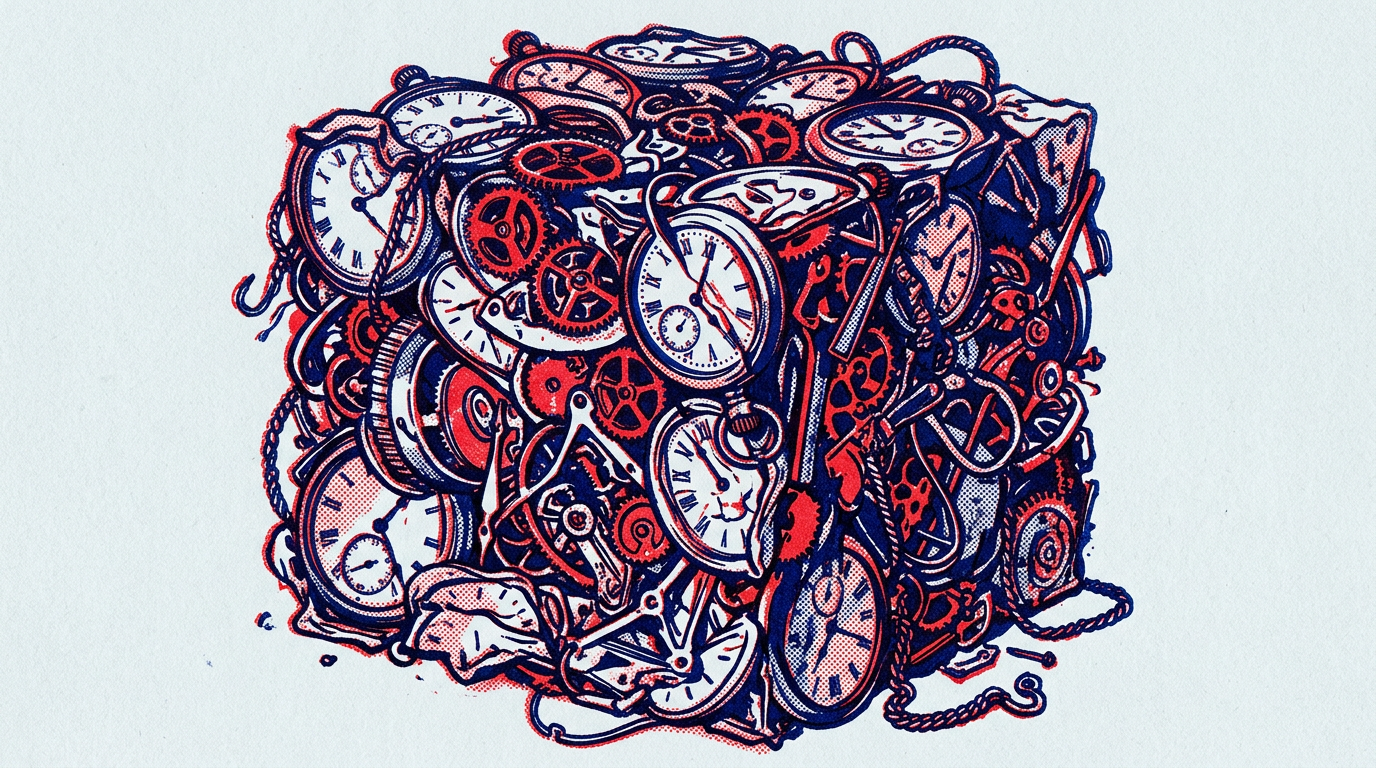
"AI Makes Us Lazy" Comforts Experts Whose 10,000 Hours Fit in a Prompt
The people most worried that machines will make us lazy are the ones whose expertise just got cheaper. The studies measure effort moving, and the hours now do more per minute of attention.
By Geordie Everitt
The argument that machines will make us lazy is a comfort. It soothes one particular discomfort, the one an expert feels on watching ten thousand hours of practice come back from a paragraph of instructions. I have that discomfort. Mine has been compressed into a prompt, and it costs me money: the market pays for what is scarce, and what I spent decades learning is less scarce than it was.
You describe a system in a few sentences. A draft returns before your coffee cools. It has the shape you would have given it, because the shape came from people who worked the way you do. "Lazy" is the word that makes the next feeling bearable.
The complaint comes from whoever paid for the skill
In the Phaedrus, Socrates tells a story in which an Egyptian king warns the inventor of writing that his gift will produce forgetfulness and hand students the appearance of wisdom without the thing itself. Socrates taught by talking. His objection came from a man whose skill was holding an argument in his head. Plato wrote it down.
The Luddites were skilled workers. In Yorkshire they were croppers, who finished woolen cloth, and the shearing frame threatened their trade. In the Midlands they were framework knitters, and one grievance was the use of "colts," hands who had not served the seven years of apprenticeship the law required. Their complaint was about the price of their years.
London cab drivers spend a couple of years memorizing the city for the Knowledge. In 2000 Eleanor Maguire scanned sixteen of them and found enlarged posterior hippocampi, with the size tracking years on the job. The study became the standard citation for the claim that a navigation app will shrink the brain. What it measured was an organ grown by memorizing a city. It cannot say what a person holding a phone should grow instead.
Writing was a way to stop remembering. The loom was a way to stop apprenticing. The map in the pocket is a way to stop memorizing. Each time, the complaint was true as a description. People did remember less. Each time it was offered as a verdict, and the person offering it held the skill the tool replaced.
What the studies measure
In 2025, Microsoft Research and Carnegie Mellon surveyed 319 knowledge workers who use generative AI weekly. Those who trusted the tool more reported less critical thinking on their tasks. It is a single survey of self-reports, so it shows what people say they do and cannot show a skill declining over time.
What it describes is effort moving. A tool exists to take over a task, and the person who hands it over does less of that task. Laziness is declining effort that would have produced something you need. Programmers wrote it into their job description in the Perl book, as a virtue, and I covered what happens to that virtue once the machine does the typing in Vibe Coding Needs Larry Wall's Three Virtues More Than Perl Did.
What ten thousand hours was
The figure comes from a 1993 study of violin students in Berlin. The best ones had averaged about ten thousand hours of solitary practice by age twenty. K. Anders Ericsson, who ran the study, said later that nothing magic happens at ten thousand and that the number is an average for violinists. Malcolm Gladwell made it a rule. It was already a compression, a round number standing in for something that could not be measured and that readers wanted to be true.
The asymmetry stings. The hours went in through a channel of about fifty bits a second, the rate a 1989 estimate put on what reaches conscious awareness, and a 2024 Caltech review put measured behavior lower still, near ten (The Bottleneck Is You has the numbers). It took years to fill the channel with what I know. It takes a paragraph to get it back out. That feels like theft, and it is also the point of the machine.
Where the fifty bits go now
The channel has not widened. Everything else about my work has. The bits used to go to syntax, to lookup, to remembering which flag does what. They go now to deciding what to build and whether the answer is right, and my hours are what let me tell a good draft from a plausible one. The hours moved from producing to choosing. Per minute of my attention, they do more than they ever did.
The hours also pay less. I wrote about that repricing in Does It Make Me Money or Does It Make Me Happy?. The second fact does not refund the first, and neither cancels the other.
The strongest version of the lazy argument is about people who never get the hours. If the routine work was where beginners put in their reps, and the routine work is automated, the next expert has nowhere to form. That is a real problem, and it is the colts' problem: a dispute over who gets to learn the trade and who pays for it. The apprentice is not lazy. The rung is missing.
Fifty bits a second, the same as when my neurons were fresh, and I have never gotten more for them.