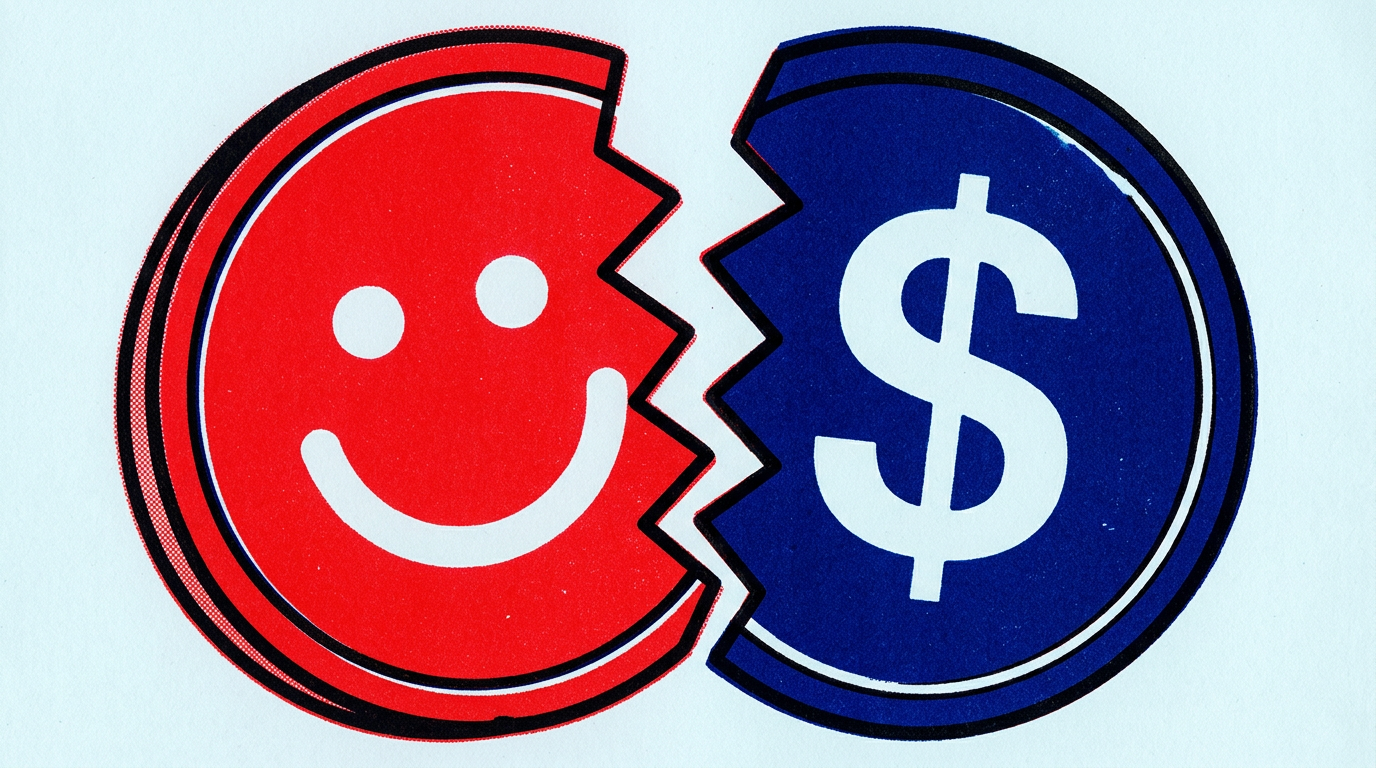
Does It Make Me Money or Does It Make Me Happy?
If you are an expert, the work you love is less likely to pay than it was. The hours still matter, so the economy has to pay for them: apprenticeships, an income floor and a citizens' fund like Norway's. Singapore's prime minister is already worried about the broken bottom rung.
By Geordie Everitt
Adam Carolla has a rubric for deciding what to say yes to. He's described it on his podcast and radio show for years. When an invitation comes in, he asks two questions.
Does it make me money?
Does it make me happy?
If the answer to both is no, he doesn't go. That's the whole system. I use it too, and it works because it's so simple.
The trap in the rubric
Either answer is enough to say yes. That's the trouble.
Say yes to happy often enough and it starts to cost you. A man's gotta eat.
So the goal is the third case, where the answer to both is yes. It's the work you'd do for free that someone also pays you for. Everybody wants that, and for a long time a lot of us got it, because the things that made us happy were intellectual pursuits, and intellectual pursuits paid.
That overlap is collapsing.
What happened to the expert
You spent years getting good at something. Maybe it was law, or finance, or medicine, or how a particular industry works. The years were the price of admission, and the scarcity of what you knew was what people paid for.
Now the machine has read what humans have written down, and anyone with enough curiosity can question it at three in the morning without paying anyone. The same is true of nearly every subject I'd want to spend a weekend on. Quantum physics. The whole discography of Pink Floyd. Every nuance, on demand.
That's wonderful if you want to learn. It takes the prestige out of being paid for knowing.
The upside is real. There are more tools than ever for people who couldn't do what they wanted to do, maybe for their whole lives. Writer's block is gone. Everybody has a muse now, one that can't be offended, never gets tired and has the sum of human writing behind it. What it gives you is flat and leans toward the average, but an average answer is still something to push against. For anything you do for love, that's a pure win.
For anything you do for a living, it's a repricing.
The hours still count
Here's what I mean, from this month.
I need a driver's license in Spain. I've been driving in the United States for forty years. I'm not fluent in Spanish, and I'm no expert on Spanish licensing rules. All the information I need exists. There are many apps that promise to teach it, and they all suck, and they're expensive.
So I vibe coded my own with Claude Code, over a weekend. It's designed for exactly one person: an American with limited Spanish and four decades behind the wheel. A year ago that was a month-long project, and not worth the effort. Now it's a weekend. I wrote up how it went in Vibe Coding for Fun and (No) Profit.
Multiply that by millions of projects that were never worth doing and suddenly are. That's the explosion, and it's real.
But I still have to learn the material. It takes weeks. The knowledge is in the cloud, millions of gigabytes of it, and for any of it to be useful it has to get into a person. A conscious human takes in about fifty bits a second. No amount of vibe coding changes that. The trip from the network to my head is a lopsided compression: the machine holds all of it, and I take in a trickle.
That's what expertise has always been. You ingest many sources, collapse them, live with them, and put in the reps until you know how to use what you know. A library has held everything for centuries, and we still needed experts.
So the question for the expert has changed. What happens to expertise when it can be channeled straight into labor, bypassing the human?
We have seen this before
The nearest analogy is physical labor. Mechanization took it over in the first industrial revolution, automation took more in the next two, and this one, the fourth or maybe the fifth, is about intellectual labor.
Where did the physical part go? Into the gym. The body evolved to need effort, so we lift weights and walk treadmills, things no job requires, because we're better for them.
Intellectual labor will go the same way. The mind that used to be paid for analysis will do the analysis for pleasure, and more of us will be on the happy side of the rubric.
The economy has to change
Here is the problem. If the value of labor goes down, people still need to eat. A system that pays people for their labor doesn't work when the labor is cheap. Capitalism needs a real reboot.
Governments are starting to see it. Singapore is famously disciplined and well educated, and it's a bellwether for what a post-labor economy looks like. Its prime minister, Lawrence Wong, said in October that AI is taking over the routine work juniors used to do: note-taking, drafting, preparing presentations for the boss. Then he named the cost.
"AI will replace all of that routine work but we should be careful not to automate away the learning that comes from it."
And: "We are concerned that there may be that bottom rung of the career ladder that is broken, and young people may not get sufficient training, and we want companies to pay attention to this."
That is the hours problem, stated by a head of government. The reps are how an expert gets made, and the reps were the routine work. Take away the routine work and nobody gets the reps.
Wong's stated line is that Singapore will embrace technology "on our own terms," and in October he said the government is looking at whether there is a need for new programs and new schemes. That's the right instinct. It needs to go further, on three fronts.
Pay for the reps. If routine work no longer trains people, companies and governments have to fund the apprenticeships and training that do.
Give people a floor. Some form of income that lets them live while they do the work that makes them happy.
Tax the savings from AI labor. Norway is the model here, and it also shows where the model breaks. Norway taxed oil, a scarce resource, and put the proceeds in a fund for everyone. AI labor is not scarce. A token, roughly a word, is the unit it's sold in, and the price of one keeps falling.
We're at our least efficient point, like the overbuilt bandwidth and dark fiber of the dot-com years. Many forces are cutting the cost of a token and raising the usefulness of even cheap ones. LED lighting replaced incandescent. Hybrids and electric cars replaced the gas guzzler. Burning more tokens has diminishing returns on productivity, and a small number of them can make a huge difference.
So a tax on tokens raises little, and less every year. The money is in the gap between what a token costs and what the labor it replaces cost. That cost is nominal next to the wages. Tax the gap, and pay it into a citizens' fund that owns shares in the whole economy, the way Norway's does. The fund buys minority stakes on the open market, holds a broad index, and pays the dividends to everyone. Citizens end up owning a slice of the companies that capture the gap, including the hyperscalers, and nobody is nationalized.
The United States has no such fund. Alaska has one for its residents, and about twenty states have funds of their own, but there is no national fund that owns shares of the economy on behalf of every citizen. The fund has to exist before the money can go into it, so it comes first.
None of this works unless the government uses the money for the people. A tax is a bargain, and it holds only when citizens see the benefit. Where the government is corrupt, and that is much of the world, nobody will swallow a new tax to fund wars and bully immigrants.
Utopia and dystopia are fiction. Nobody reaches either one. What real societies have is a direction. Kevin Kelly calls the good one protopia: you set policies toward a more perfect union that you'll never fully reach, and each year is a little better than the last. The bad one needs a name too, and I'll call it entropia: a society that is slowly running down, where trust erodes, the money goes to the wrong things, and each year is a little worse.
AI will push every society one way or the other. Norway and Singapore are the models because they've spent decades earning the trust that keeps them pointed toward protopia. Everywhere else, the trust comes first.
The two questions, answered separately
Until the economy catches up, the rubric still works when the two questions are answered separately, about every AI tool and every invitation.
A yes to happy is reason enough. The book gets written and the language gets learned. Nobody needs a business case for joy.
A yes to money deserves a hard look at why. A tool anyone can pick up pays less every month. What stays valuable is what the machine can't hand over: the hours you've put in, your judgment, and knowing which of what it says is true.
The best case is still both. It's harder to find than it was, and finding it again takes an economy that pays people to put in the hours.