How LinguaMama Got Built, Part 5: Tavira
After the visas, the lost passport, the French EV, and the broken chargers, we made it to Tavira. It was worth it.
By Geordie Everitt
We had been ready for Tavira since October.
This is true in the financial sense — the lease had started while we were still in Florida, still surrendering our passports to a VFS office, still searching the Dungalow for a document that was not there. The flat had been sitting empty and paid-for through all of it. But we had also been ready in the other sense: the sense in which you prepare for a place by watching every piece of content ever produced about it, by corresponding with the people who had gotten there before you, by building a mental model of somewhere you've only visited once and are now betting on considerably.
We pulled in as the sun finished setting. The grey of the A2 was behind us. Tavira in the last light was something else entirely.
Terry and Clyde
One of the YouTube channels in our rotation — there had been many, as documented — was run by a couple named Terry and Clyde. They had moved from Corpus Christi to Tavira, by way of Panama, which is a longer story than we ever got the full version of, and one that suggests an appetite for relocation that made our own look tentative by comparison. At some point they had filmed a piece for International Living from Tavira — the kind of segment that lands in the algorithm of people who are, as we were, in the research phase of a decision they have already made.
We had corresponded. This is one of the more pleasant features of the expat community: the people who got there first tend, with notable generosity, to help the people who are arriving. Terry and Clyde had gone to the flat before we did. Checked it out. Turned things on. Made sure it was in order.
When we opened the door, there was a bottle of wine on the kitchen counter.
Local wine. Alentejo, probably, or possibly one of the Algarve producers — in either case, Portuguese, and in either case an introduction to a fact that we would spend the following months confirming from multiple angles: Portuguese wine is extraordinary, and it costs approximately what you would expect to pay for a bottle of water if water were the thing you were buying instead of wine. This is not an accident of the market. It is a structural feature of a country that produces excellent wine and has not yet fully explained this to the rest of the world.
We opened it immediately.
The Flat
The complex was built in 2008 — modern by Tavira standards, which run considerably older in the center of town. For those of us from the Suncoast of Florida, the aesthetic had a faint timeshare quality: clean lines, tiled surfaces, amenities that had been selected for their inoffensiveness rather than their character. This is not a criticism. After months of the Dungalow, inoffensiveness had considerable appeal.
The kitchen was enormous. Disproportionately enormous, in the way that European apartments sometimes distribute space according to a log that doesn't translate directly from American assumptions about which rooms matter. Two bedrooms. A bathroom with a bidet, which neither of us had personal experience operating and which we approached, in the early days, with the caution appropriate to an unfamiliar piece of infrastructure.
The toilets were, as advertised by everyone who has ever moved from America to Southern Europe, different. Not wrong. Different.
Over every window: rolling shutters. Metal slats on a mechanism, lowered by a strap or a switch depending on the vintage of the installation, capable of achieving a darkness at noon that the Suncoast, for all its blackout curtains, has never managed. In Pinellas County we would have called them hurricane shutters and understood them as emergency infrastructure. Here they were simply the windows — the way windows work in a place that takes summer heat seriously. We learned to use them within forty-eight hours and have not gone back.
Archer investigated the flat with the thoroughness of an animal conducting a professional inspection, determined that it met his requirements, and selected a patch of tile in the kitchen that caught the afternoon light. He has not moved from it in any meaningful sense since.
New Year's Eve at the Roman Bridge
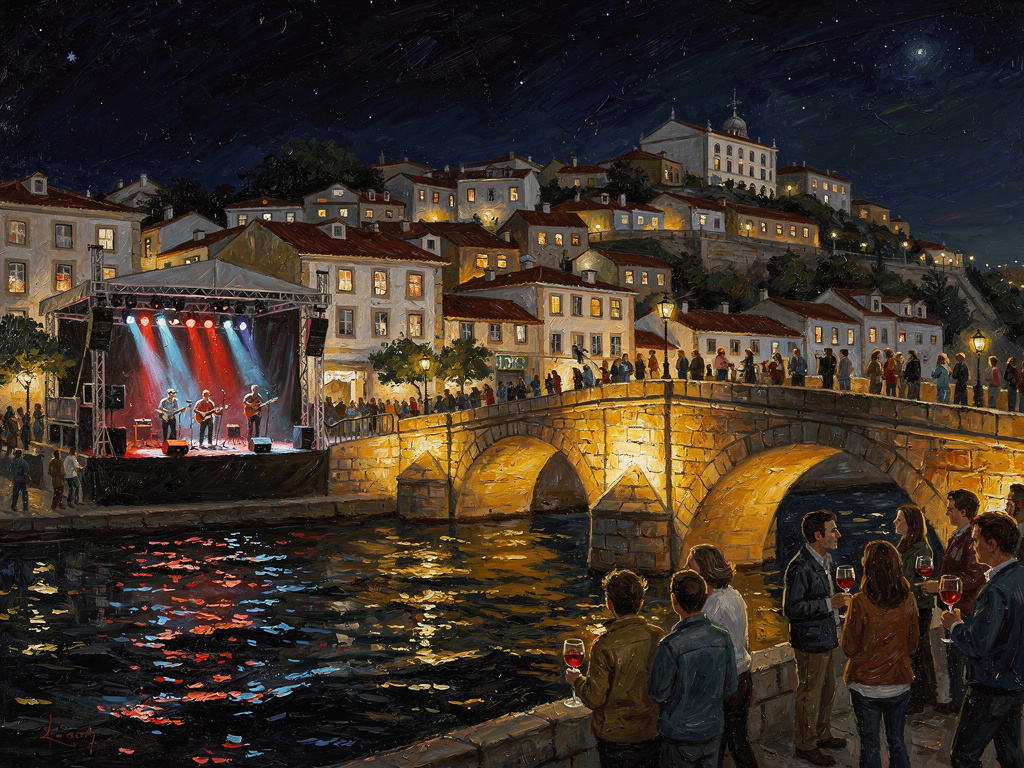
Tavira has a Roman bridge. This is not a metaphor or a marketing claim — it is an actual bridge of actual Roman origin spanning the actual Rio Gilão, which runs through the center of town, and around which the actual center of town has been organized for approximately two thousand years. The bridge is narrow, arched, made of stone, and lit at night in a way that suggests whoever is in charge of the lighting has thought carefully about the effect they are going for.
On New Year's Eve, they put a stage at one end of it.
The band was from Porto. They played Queen. Specifically, and for reasons that were never fully explained, they played Queen songs from the 1980s. This is a more specific subset of the catalog than you might expect a cover band to commit to, and it produced a setlist that included, with apparent seriousness, material from The Miracle — an album that performed modestly in the United States and, it turns out, considerably better in Europe, where its existence is not a trivia question.
The crowd knew the words. All of them. To songs that, in the Florida of my experience, would have required a very particular kind of music nerd to identify by name.
We stood by the Roman bridge in the cold and the dark of a Taviran New Year's Eve and watched a Porto cover band play I Want It All to a crowd that was entirely ready for it, and we drank wine that cost less than water, and at some point around midnight someone set off fireworks over the river.
Tavira is charming as fuck.
Part 6: Three months, a Portuguese bureaucracy, and the language that was no longer optional.