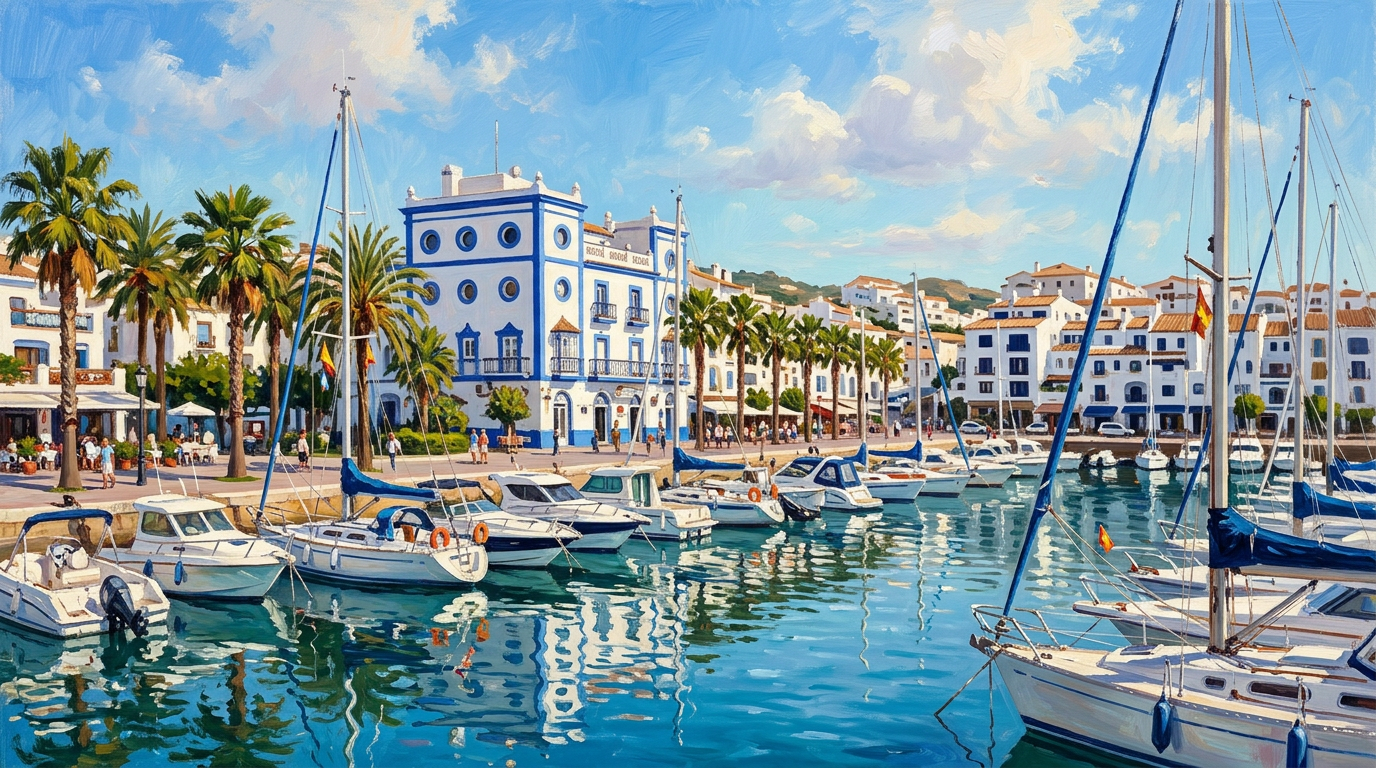
How LinguaMama Got Built, Part 8: Estepona
The DNV paperwork meant Geordie had to become the primary visa holder. One week in Estepona to build the file. Three apartment listings. One cat.
By Geordie Everitt
The street the Airbnb was on had hanging flower pots.
This is not unusual for a street in the south of Spain. The distinction is that Calle Pintada's flower pots were tended — blooms current, the yellow stucco behind them freshly maintained, the cobblestones swept. The street curved gently uphill toward a church. The building was yellow. Not aggressively yellow, not the yellow of a franchise trying to signal friendliness — the yellow of a place that has always been that color and sees no reason to discuss it.
Two blocks away: Calle Terraza. Marble tiles. Pedestrians only. Ice cream, apparently in unlimited supply, and more shoe stores than the population of one small city could plausibly support. Spaniards take their zapatos seriously. I counted the stores. I am not going to tell you the number because you won't believe it.
Part 7 ended with a claim about Estepona. Consider it substantiated.
The Paperwork Inversion
The Portuguese D7 had taken nine months to assemble. Maria was the primary applicant — her pension, her documented income, the clean financial profile of a person who had organized her life against exactly this kind of scrutiny. I was her dependent. A dependent's file is thin by design: you exist in relation to someone else's paperwork, which is a relaxed way to enter a country.
The Spanish DNV is different in a specific way that I had not fully internalized until we were standing in a flat in Estepona with one week and a Madrid law firm on retainer.
The primary holder must demonstrate active consulting income. Not passive income. Not retirement savings. Documented earnings from clients, distributed across more than one of them, organized into a coherent narrative rather than existing — as mine did — as a collection of wire transfers, tax returns, and client contracts in various states of legibility across several hard drives and two countries.
The income was real. The file was not yet a file. I had seven days to make it one.
We had also paid €6,000 to the law firm, which is the price of having someone who knows exactly which documents the immigration office expects, in which order, formatted how, and what happens when one of them is missing. The answer to the last question is: you come back. We did not want to come back. We built the file.
The fingerprints were a separate errand. FBI fingerprints — required for the criminal background check portion of the application — cannot be obtained at a notary or a pharmacy. They require a visit to the Policía Nacional headquarters. We found the building without difficulty. It looked exactly as bureaucratic as you would expect a federal police headquarters to look, and the process inside was as brisk and procedural as its exterior suggested. We were in and out in forty minutes.
Gibraltar
There is no passport control between Spain and Portugal. This is how the Schengen Area works: you drive across a bridge and you are in a different country and nobody stamps anything. Going from Tavira to Estepona is like going from Mississippi to Arkansas — different state, same road, no checkpoint.
The DNV application requires documented legal entry into Spain. A stamp. Evidence, in the form of an official record, that you arrived through a recognized crossing rather than simply appearing, unstamped, on the wrong side of a river.
We needed a hack.
Maria had never been to Gibraltar. I had last been there in 2002. Gibraltar is not Spain: it is a British Overseas Territory, a limestone rock at the entrance to the Mediterranean with its own currency, its own border crossing, and a set of cultural assumptions that differ from the country on both sides of it. You enter Gibraltar from Spain. You exit Gibraltar back into Spain. Each crossing involves passport control.
Entering Spain from Gibraltar is entering Spain legally — documented, stamped, on the record.
A day trip to Gibraltar was clearly the thing to do. The legal entry was a side effect.
The Signs
One of the quieter pleasures of building a language app is that you start noticing signs.
I had grown up in Tampa. I had spent time in Ybor City, the historic Cuban neighborhood where the sandwich of the same name — which is to Cuban food what the burrito is to Mexican food — achieves something close to its theoretical maximum, and where the Columbia Restaurant — which opened in 1905 and occupies an entire city block with the confidence of an institution that has decided it is not leaving — had provided me with paella on more than one occasion. I was, in other words, comfortable in a city where Spanish competed aggressively with English on menus, on storefronts, on the sides of trucks.
In Tampa, English is on top. Spanish is the translation.
Standing on Calle Pintada in late February, I found myself reading signs where Spanish was on top and English was below it. Same information. Reversed priority. The implied native speaker of the sign had changed.
I noted this with the specific satisfaction of a person who has spent months studying a language and is now, for the first time, correctly oriented to the signs around him. It is not fluency. It is not even comprehension, exactly. It is something more basic: the sense that you are standing in the right place for the language you have been learning, rather than a place that has made room for it.
Tampa, for the record, does not feel that way about Spanish. Estepona does not feel that way about English.
Three Listings
Idealista is the Zillow of the Iberian Peninsula. We had used it to find the flat in Tavira. We were using it now to find a permanent place in Andalucía. Framing this as contingent on the DNV would have been backwards: you cannot file without a Spanish address. The apartment was not the consequence of the application. It was a condition of it.
The search criteria were: price, location, availability, and Archer.
Archer is the cat. He weighs approximately four kilograms and has expressed, throughout this journey, a philosophical indifference to international relocation that I find either admirable or mildly unsettling depending on how much sleep I've had. Spanish landlords have strong views about cats. The search results reflected this. Exactly three listings met all four criteria.
The first could have been in Sarasota — or more precisely, off International Drive in Orlando. It sat in Saladillo-Benamara, in the corridor between Estepona and Marbella where the Costa del Sol achieves its most concentrated form. Parking lots rather than garages: more Citroëns than Escalades, otherwise the same arrangement. Traffic roundabouts scaled like small civic systems. A lovely garden. A well-tended pool. It had amenities. It had a gym. It had that particular timeshare quality — the managed, buffered atmosphere of a complex with no special relationship to the country it happens to be built in. As best I could tell from the listing photographs, there was no town anywhere near it.
As it happens, the Saladillo-Benamara development boom and the Disney World boom occurred at approximately the same time. The area has four golf courses within golf-cart distance of each other. These facts explain each other.
The eastern Algarve is not dense. This is one of the things it has going for it. The Costa del Sol, as you drive west from Gibraltar, is considerably denser — and then, as you approach Estepona, it breathes out again. Estepona has managed, through some combination of planning policy and fortunate geography, to remain a town that functions like a town. Old Town in particular: Calle Pintada yellow and tended, the marble pedestrian street, the church on the hill, the shoe stores.
We had both grown up on the American Suncoast, which executed the gated golf community concept at a scale that remains unmatched in the developed world. There is a version of expat relocation that simply replicates this pattern: different country, same gate, same lawn service contract, same neighbors from the Midwest. We had not come five thousand miles to find it.
Estepona was not that. The other two listings were in Estepona.
The 200-Meter-er
There is a concept — applicable to cars, apartments, and certain people — called a twenty-footer. Something that looks great from twenty feet away. The second listing was a twenty-footer at twenty feet. From closer range, it was something else.
In Idealista's overexposed HDR photographs, it had looked like a penthouse. It was, technically, a penthouse — the tenth floor of a three-tower complex overlooking the Port of Estepona, which is less a port than a marina dressed in port's clothing. One block from the bullfighting ring. Views across the water. Spacious rooms in the photographs, which is a phrase that means something specific when the photographer has used a 10mm lens.
We were now operating in SI units. The listing was a 200-meter-er.
Post-Franco "modern" architecture — the kind built in a hurry during the boom years after 1975, when Spain was constructing its way into the twentieth century with the urgency of a country that had missed several decades of it — has a particular look when it has had fifty years to oxidize. White paint, navy accents. A color combination I genuinely like, when the white is not chalky and the navy has not faded to the color of a worn denim jacket in a charity shop. The building had been handsome, once. The photographs on Idealista had captured this period of its life.
The apartment itself was spacious. European flats are quirky to Americans accustomed to the kitchen dimensions of a Suncoast suburb — the counters are not continuous, the appliances are not hidden, there is no garbage disposal because the pipes are not engineered for one, and the washer is a compact unit under the kitchen counter that is emphatically not accompanied by a dryer. We had been prepared for all of this.
We had not been prepared for the price, which was higher than the other listings without corresponding justification. Or the furnishing situation, which was none. Or the general atmosphere of a place that had once been someone's dream and was now being monetized by someone else.
Hard pass.
WhatsApp and the Matronly Spaniard Who Was Not
By Tuesday we had four days before we needed to be back in Tavira, one listing left, and a WhatsApp thread that did not inspire confidence.
If you live in Europe, WhatsApp is infrastructure. Not a messaging app — infrastructure, in the same category as electricity and running water. Medical appointments, building management, school pickups, property rentals: all WhatsApp. The person at the other end of this particular thread had posted the third listing — also near the Port of Estepona, exact location unspecified — and her responses had the cadence of someone being cautious in a second language, or possibly just cautious.
Maria had formed a mental image: a matronly Spanish woman, somewhat fussy, understandably wary of foreign tenants who would not understand the customs around garbage separation and might leave the shutters open in August. This is a reasonable archetype for the Spanish rental market. It is also a projection.
The listing said pets allowed. The landlord said she didn't allow pets. We explained that we were leaving in three days and could we please see the flat regardless. She said there were current tenants and they would need time to clean. The price was two hundred euros per month less than the chalky penthouse. The whole exchange had the texture of a situation that was either going to work out fine or not work out at all, with no obvious middle ground.
It sounded very sus. We went anyway.
Freddie
The building was called Edificio Faro. Lighthouse Building. A ten-minute walk from Old Town through streets that opened gradually into the port area — a part of Estepona we had not yet reached in ten days of walking the old town grid. The landlord had said to meet her at the entrance on Avenida de Carmen, across from the Plaza de Toros.
We were standing at the entrance when a young woman came around the corner with a tiny Pomeranian on a leash.
She was not the matronly Spanish woman we had imagined. She looked to be in her late twenties. She spoke with a posh British accent — grew up here, she said, by which she meant Estepona, not Britain, which is a sentence that requires Estepona to have been producing posh British accents for at least one generation, which it has, because the Costa del Sol has been producing posh British accents for two.
Her name was Freddie. She was effing delightful.
Freddie produced keys. Actual keys — multiple, for a succession of glass doors between the street and the lobby. No keycards. No NFC sensors. A security system designed in 1988 and not reconsidered since, which I found either charmingly anachronistic or usefully reliable, depending on how much faith you have in physical mechanisms that have worked since the Bronze Age.
The main elevator was out of service. We were standing at the −1 level — European buildings count from ground, so the entrance was a basement and the flat was on the fifth floor, and the operative lift was around the corner. Freddie knew where it was.
The tenants were in. A lovely older British couple, unhurried, set to leave at the end of March. The timing aligned with our deadline precisely enough that it felt less like coincidence and more like the paperwork had been waiting for this apartment. Our Schengen visas expired on March 27. To stay in Spain past that date, we needed to be under active DNV protection — formally in process, formally resident, not merely visiting. The lease start date was not a preference. It was the only one that worked.
The View
The flat was cozy. European cozy, not American cozy — a distinction with consequences. Two bedrooms. Two bathrooms. A galley kitchen — compact, complete, no garbage disposal, washer under the counter, no room wasted on ambition. The nautical theme was in evidence throughout: navy accents, a rope detail somewhere, something that suggested the decorator had opinions about what was outside the window.
The view.
I had lived on a barrier island in Tampa Bay for twenty years. Three stories, 2,500 square feet, the properly proportioned American house with the kitchen to prove it. I had not been aware of a water-view-shaped absence in my life. I had not missed it. It had not occurred to me to miss it.
The fifth floor looked out over the marina, the Mediterranean, the Rock of Gibraltar, and the Moroccan coastline. Africa. Visible on a clear morning, thirty-five miles across the water. The bullring was down there too — close enough that we had quietly revised our assessment of it, somewhere between the Idealista listing and the living room, from "concerning" to "historic." Charming, even. A thing you look at.
The Trigger
Freddie walked Maria through the lease terms. I was on a business call — the client did not know I was standing on a terrace in Andalucía evaluating what the next chapter of our lives was going to look like, and I could not tell them, so I discussed the project with my full professional attention.
Afterward, we walked to the parking garage. The space was included. It fit the Yaris Cross with margin. We noted this.
In the elevator back up, with Freddie and Puccini — the Pomeranian, whose name I should have given you earlier — Maria leaned close and said, in the register of a whisper that carried clearly in the small space:
"Do you want to pull the trigger? Because I want to pull the trigger."
We are, typically, circumspect. We would usually have thanked Freddie warmly, said it looked wonderful, and promised to be in touch by end of week.
We told Freddie we were in.