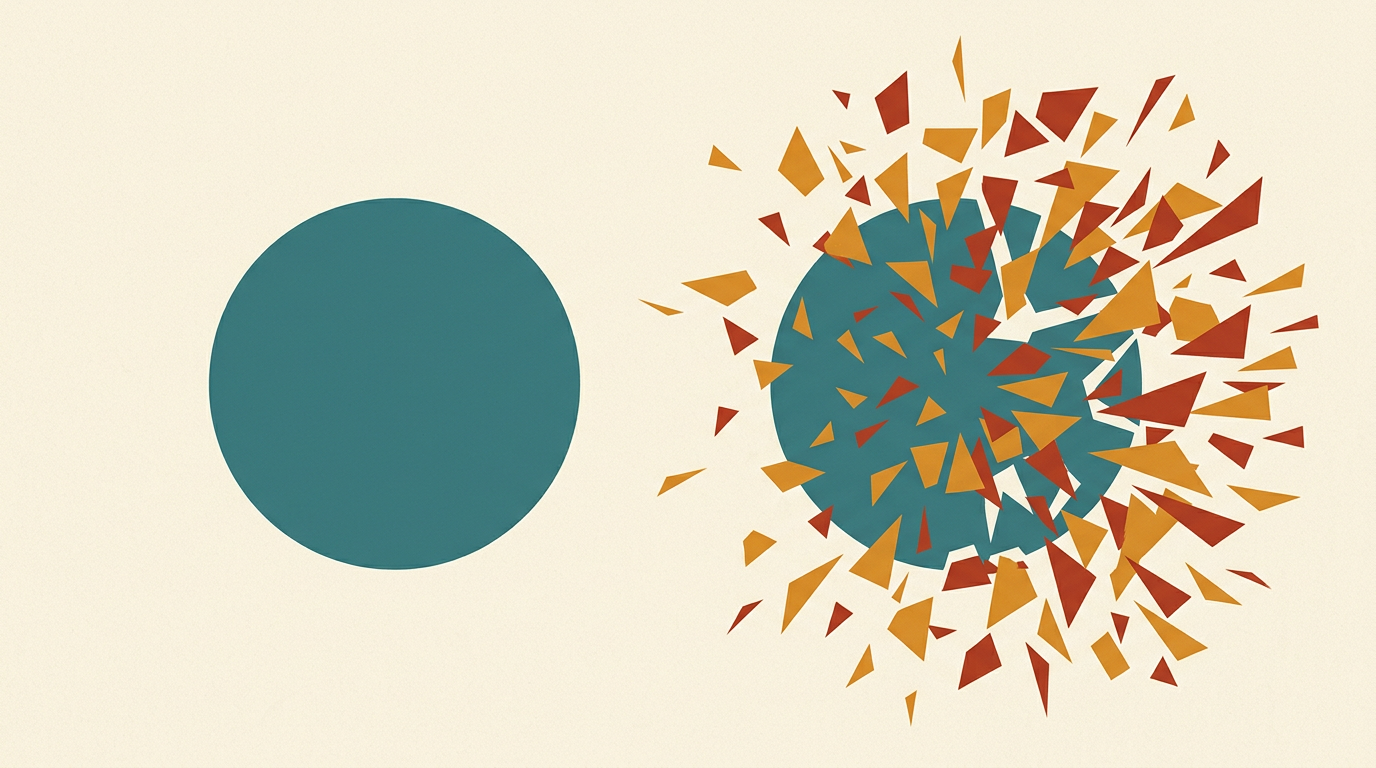
A Tale of Two Bubbles
The consensus name is wrong by one word. On the difference between a financialization bubble and a technology, and why only one of them pops.
By Geordie Everitt
The consensus has arrived at a name for the thing we are standing in. It calls it the AI bubble. The name is wrong by one word.
We are in an AI financialization bubble. The multiples have left the stratosphere and are now transmitting faintly from somewhere out past the orbit of Neptune. There is no arithmetic that survives contact with a spreadsheet and still reconciles what the financial elite have poured into this space with a return to anyone whose investment horizon is shorter than the life of a parrot. A grey parrot lives about fifty years. That is the horizon on offer, and it is being sold to people who would like to retire.
That is bubble one, and it is going to pop. It smells like 1998 in here, with a top note of 2007. The tell is not the exuberance — exuberance is cheap and always in stock. The tell is the elaborate machinery now being assembled to explain why the arithmetic does not apply this time: the adjusted metrics, the decks, the confident men explaining that capital expenditure is really revenue if you squint at the depreciation schedule from the correct angle. I have catalogued the predecessors elsewhere. The music is still playing.
The fiber stays in the ground
Two things are being priced here, and only one of them is inflated.
The first is the paper — the equities, the rounds, the pre-revenue multiples, the men. The second is the technology, and the technology is not in a bubble. It is doing what technologies do, which is to arrive, eat a category of human effort, and stay.
The internet bubble was an internet financialization bubble. It burst in 2000 and took the paper, the options, and a great deal of nerve. It did not take the fiber. The fiber stayed in the ground — dark, unloved, and fully paid for — and a decade later it was carrying Netflix into your living room. A collapse very seldom takes out the infrastructure. It takes out the people who financed the infrastructure on a schedule the technology never agreed to.
No technology was ever immune
Nor was any of them meant to be. The internal combustion engine handed our species a freedom of movement it had not enjoyed in four hundred thousand years of walking, and it is cooking the atmosphere — a cost that appeared on no prospectus.
The electric motor did something stranger. It vanished. There are more than a dozen of them in a Toyota Yaris — in the windows, the mirrors, the seat rails, the fuel pump, the wipers, the fan — and you have never once thought about a single one. Hand-cranking a car window used to be a small daily task performed by a human arm. Now it is a button. The motor that made it a button has no name, no brand, and no advocates. There was never a manifesto for the window motor. There were no conferences.
The value was real, permanent, and almost entirely invisible. That is what winning looks like for a technology: it eats a form of drudgery and then disappears into the appliance, so completely that the grandchildren cannot be made to believe the drudgery was ever there.
Cognitive labor is labor
Which brings us to the infrastructure actually being made obsolete, and to why the noise around this one is so loud.
The infrastructure this time is made of people. It is made of cognitive labor — which is labor, whatever the people performing it have been encouraged to believe about themselves. We have been mechanizing the physical kind for three centuries and calling it progress: the loom, the thresher, the pump, the washing machine, the assembly line. Each one ate a category of drudgery. Each time, the people whose hands did that work were told — correctly — that the work was not coming back. And each time, the telling was done by someone whose own work was not yet on the list.
What is new is the collar. The mechanization has been climbing for three hundred years and it has arrived at the desk. That is the whole novelty: the altitude.
The frames were the weather
The Luddites turn up on schedule in every conversation like this one, deployed as a slur for people too dim to see what was coming. They were not dim. They were skilled croppers and framework-knitters who saw what was coming with perfect clarity — and saw that it did not include them. They were right about the outcome and wrong about the remedy, which was to go at the machines with hammers. Breaking the frames did not stop the frames. The frames were the weather.
The backlash is coming for this one too. It will be just as sincere and just as futile. It will have better graphics.
You cannot vote on the rain
It is fashionable to say that you cannot spot a bubble from inside one. You can. People spotted 1999 and said so. People spotted 2006 and said so, in print, with charts, and were early — which in that trade is indistinguishable from being wrong. Seeing it has never been the difficulty. Doing anything about it is the difficulty.
Which is why the weather is the only metaphor I trust here. You can read the sky. You can bring a coat, move the livestock, sell in May and go away. What you cannot do is convene a committee and vote on the rain.
So: the financialization bubble will pop, and it will land roughly where it landed the last two times, which is not on the people who inflated it. The technology will carry on, because the value underneath it is real, and because three centuries of mechanization have yet to reverse on account of a market correction. Both of those things are going to happen. They are not the same event, and the name we have been using smears them into one.
Prepare accordingly. And if you catch yourself reaching for a hammer, look hard at the frame in front of you. It was never the thing that was coming.
Published under the name Geordie.