How LinguaMama Got Built, Part 3: You Cannot Come to Portugal
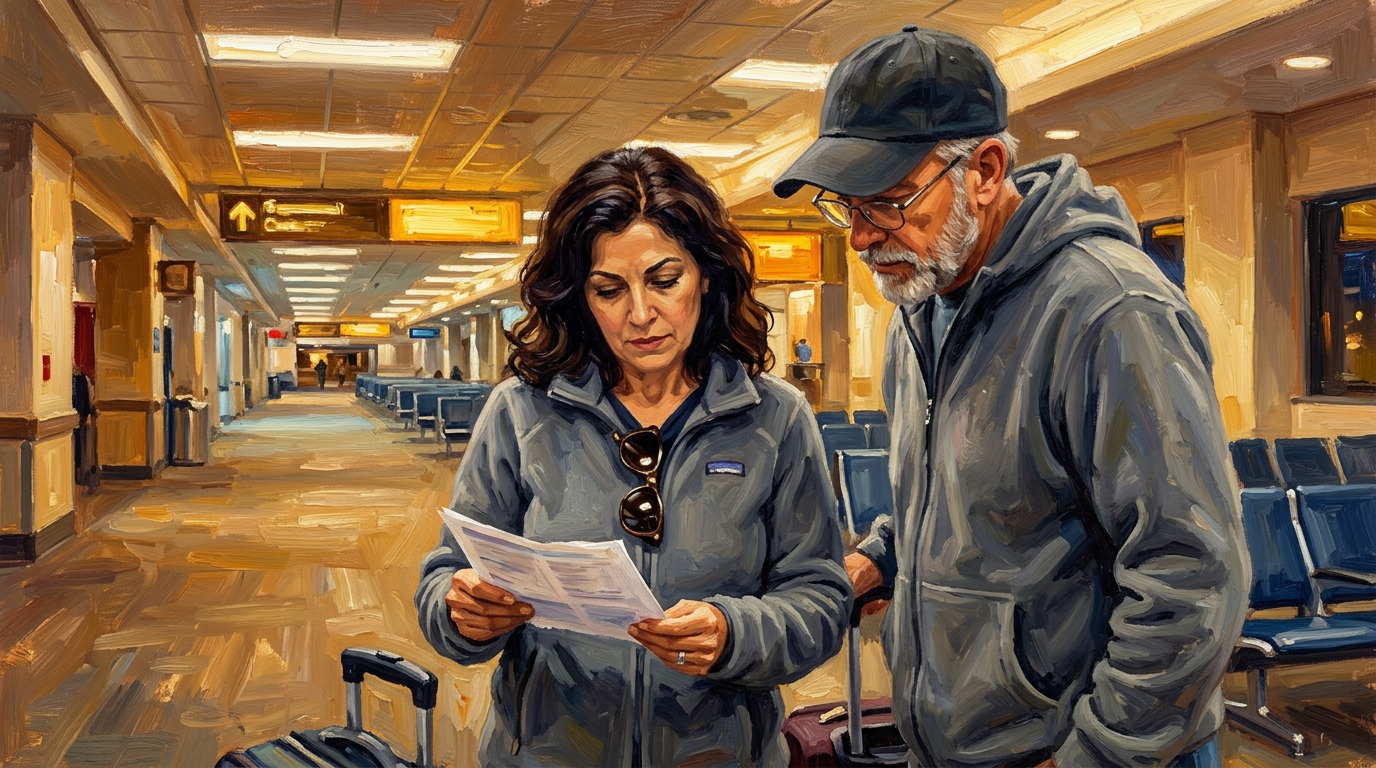
Our attorney said we couldn't come. We were paying for a flat we'd never seen. We rebooked for December 26 and went to see butterflies instead.
By Geordie Everitt
"You cannot come to Portugal."
This was the advice of the attorney we had retained to help us navigate the Portuguese immigration system. She delivered it in late November, with the calm of someone who had already mentally departed for the holidays. Which, in true European fashion, she had. Most of December, it turned out, was spoken for.
We considered this advice for approximately the amount of time it deserved.
The Situation, Assembled
To understand what "you cannot come to Portugal" meant in practice, you need the timeline.
On October 6th, we had appeared at the VFS Global office in Miami — the private contractor Portugal uses to process visa applications from Americans, one of several intermediary layers inserted between the applicant and any actual government employee who might feel some obligation to help. We surrendered our passports. This is standard. The passports go to the consulate, the consulate reviews the application, the passports come back with or without a sticker inside.
What is less standard is the duration. Portugal held our passports for six weeks.
During those six weeks, we continued paying rent on a flat in Tavira we had never entered. The lease had started in October — we had signed it from Florida, paid the deposit from Florida, and were now funding a life in the eastern Algarve from a Dungalow in Dunedin while our identification documents sat in a consulate processing queue. This is the texture of the immigration experience that the YouTube channels tend to skip.
The passports came back. Both of them. With stickers inside.
We booked flights immediately. TAP Air Portugal, December 10th, $800 one way. A genuinely good price, as these things go. We allowed ourselves a brief moment of feeling like people who had figured something out.
Then Maria lost her passport.
This requires a small digression, because the sentence does not land correctly without context.
Maria is not a careless person. She spent years as an oncology nurse — a profession in which the consequences of inattention are not abstract, and where a bias toward precision and action gets reinforced daily by the simple fact that the alternative is not acceptable. She is the person who knows where things are. She is the person who notices when something is not where it should be. In any partnership, there is usually one person who functions as the institutional memory for the location of important objects. In ours, that person is Maria.
I am not that person. Many people who know me well would confirm this without hesitation and probably with some relief that I've acknowledged it in writing.
So when the passport went missing, there was grief, and there was panic, and there was the full machinery of crisis running at full speed — and underneath all of it, very quietly, a small and somewhat shameful awareness on my part: at least it wasn't me. If I had been the one to lose the visa passport, I'm not entirely certain we would have recovered. Not because the bureaucratic outcome would have been different, but because I would not have survived the scrutiny. Maria lost something she had no business losing, and it was still, in some ways, the best possible version of the disaster.
One Week, Every Drawer
The Dungalow is not a large space. This is relevant because we searched all of it. Repeatedly. Over the course of a week that blurred together into a continuous loop of furniture-moving and inventory-checking and increasingly desperate re-examination of places we had already looked.
There is a particular texture to this kind of searching that is hard to describe to someone who hasn't done it — the way certainty and doubt alternate with each pass, the way you become convinced that the tenth look will reveal what the nine previous ones missed. We moved every piece of furniture. Checked every pocket of every bag. Went through the trash. Went through the recycling. Went through items we had already set aside to donate, items already boxed, items we had been systematically dismantling from fifty years of accumulated American life and converting into the smaller, more portable version of ourselves we needed to become.
That context matters. We were already in the middle of a sustained confrontation with the material evidence of five decades of existence — some of it genuinely meaningful, most of it the ambient accumulation of a consumer culture to which we had not been immune. The grief was already present before the passport went missing. Kübler-Ross was already running. Adding a missing government document to an environment already thick with loss produced exactly the response you'd expect, and no amount of knowing better made the machinery run differently.
We did not find the passport.
The Attorney's Advice
The realization, when it arrived, was obvious in the way that obvious things tend to be unavailable during crises.
It's a stamp. Not the permit itself — the permit exists in a Portuguese government database. The passport is merely the physical object they chose to affix the evidence to. People lose passports constantly. There exists, somewhere in the Portuguese immigration system, a procedure for exactly this.
We engaged the attorney to find out what that procedure was. She found out. She reported back. And then she explained that navigating it would take time that we did not have — that the relevant office would not move at the speed our December 10th departure required, that the holidays were approaching, and that his considered professional recommendation was that we should not attempt to come to Portugal in December.
We were paying for a flat in Tavira. We had $800 flights booked. We had been paying rent for a place we had never been in. We had sold the house. We had sold most of what was in the house.
"You cannot come to Portugal" was not, in the end, advice we were going to take.
The Butterfly Garden
There is a legal provision, unremarkable in its simplicity, that had been sitting in the applicable regulations the entire time: American citizens can spend up to 90 days in the Schengen Area as tourists. Our flat in Tavira is in the Schengen Area. We could enter as tourists, live in the flat we were already paying for, and sort out the visa documentation from inside Portugal rather than from a Dungalow in Dunedin. The stamp in the missing passport was relevant to our eventual residency application. It was not relevant to December 26th.
We rebooked the flights. TAP Air Portugal, December 26th. The one-way price was considerably less of a bargain by then, because flights on the day after Christmas to Lisbon turn out to be a thing people want.
The week before departure we spent in Fort Lauderdale. Booked an Airbnb. Made an appointment at the US Passport office — Maria needed a new one, the old one being wherever it was — and waited, which is what you do at passport offices. They are, in this one respect, not meaningfully different from their Portuguese equivalents, except that the staff occasionally make eye contact.
Between the appointment and the flight, we went to a butterfly garden.
This is not a metaphor. It was a greenhouse full of tropical butterflies in Coconut Creek, Florida, and it was genuinely pleasant, and we were genuinely glad we went. I mention it because the week also included the full inventory of everything we were leaving: the traffic on I-95, the signage, the size of everything, the number of lanes, the quantity of advertising visible from any given point, the pervasive and apparently load-bearing role of morbid excess in the architecture of daily life. The list I had been keeping — things I was not going to miss about the United States — grew considerably that week. The butterfly garden did not make the list.
On December 26th, we flew to Lisbon.
Part 4: Tavira. The flat. The paperwork. And Portuguese, in practice, in a place where it is not optional.