How LinguaMama Got Built, Part 4: Do Not Get a French Car
We landed in Lisbon at 5:30 AM with everything we owned, one cat, and a rented Citroën. The charger didn't work. My European friends had warned me.
By Geordie Everitt
We landed at 5:30 in the morning, into a darkness that did not lift.
This is not a good time to land anywhere. Lisbon's airport at 5:30 AM on December 27th is a specific experience — the particular fluorescent exhaustion of a terminal that has been running continuously through the holidays, staffed by people who have also been running continuously through the holidays, processing an unbroken stream of passengers who all made the same calculation about cheap post-Christmas fares. We joined the queue.
Outside, it was cold. Not dramatically cold — not Wisconsin cold, not cold that makes a statement. Portuguese cold, in December, is the cold of a place that considers itself Mediterranean and resents being reminded otherwise. It is damp in a specific way. It finds you. The sky, when it eventually became visible, was the color of wet concrete and showed no interest in changing.
Customs, mercifully, moved. The airport vet — because there is a cat in this story, and crossing an international border with a cat requires documentation and an examination by a licensed veterinarian at the port of entry — also moved. The cat, Archer, who had spent eight hours in a carrier under the seat in front of Maria, emerged for inspection with the composure of an animal who had decided that dignity was the only available response to indignity, and was processed without incident.
Then we piled everything — two people, one cat, and the luggage of two people who had spent months converting a household into the maximum viable carry — onto a cart, navigated to the rental lot, and took possession of a Citroën C4 electric.
Twelve Years of Opinions
Some context is required.
Maria and I were both Tesla owners back when that meant something specific — when buying a Model S was a statement about what you believed the future looked like, made at a price point that only made sense if you believed it loudly enough. I took delivery of Phthalo Joule in 2013. The Supercharger network didn't exist yet in any meaningful sense. Range anxiety was a real operational constraint, not a talking point. You learned, in those early years, to think carefully about charging the way you think about fuel when you're not sure where the next station is — not with panic, but with attention.
Twelve years of that. Twelve years of watching the infrastructure build out, of trusting a network that worked because one company had decided that charging couldn't be an afterthought. We knew what competent looked like.
We were also, by December 2025, no longer Tesla owners in the political sense. The brand had acquired new associations. The man who built the Supercharger network had become, in the intervening years, a figure whose enthusiasms I did not share and whose role in the events of November 2024 had been, from my perspective, directly relevant to why I was standing in a Lisbon rental lot at six in the morning. This created a tension I was not entirely sure how to resolve. I filed it.
Tavira is walkable. The Algarve has regional rail. These facts appear in approximately every expat relocation video ever produced about Portugal, cited as evidence that car ownership is optional. This may be true for people moving to Lisbon or Porto. We were moving to a town of twenty-six thousand people in the eastern Algarve, and we were not ready to surrender the personal automobile — the most American of American things, the freedom infrastructure, the option value of being able to leave whenever you wanted without consulting a timetable. We would get an EV eventually. In the meantime: rental.
I had done the reconnaissance. On the previous trip, driving back from Tavira toward Lisbon, I had noted the charging infrastructure along the A2 — the extremely limited-access toll motorway that is essentially the only road between Lisbon and the Algarve. There were chargers. Modern-looking ones. High-speed, or so they appeared. I had filed this as: adequate.
My European friends had offered a different assessment. "Dude," said one of them, with the emphasis of someone who had been here before, "do not get a French car." I had attributed this to the particular variety of inter-European automotive parochialism that I had also noted in the expat forums, where opinions about car brands carried a cultural charge that seemed disproportionate to the underlying engineering question. I rented the C4.
The A2
The road south from Lisbon is beautiful. I knew this because I had driven it in April, on the reconnaissance trip, when the light was warm and the cork oaks were doing whatever cork oaks do in April, and the whole country looked like an argument for moving there immediately.
December is a different argument.
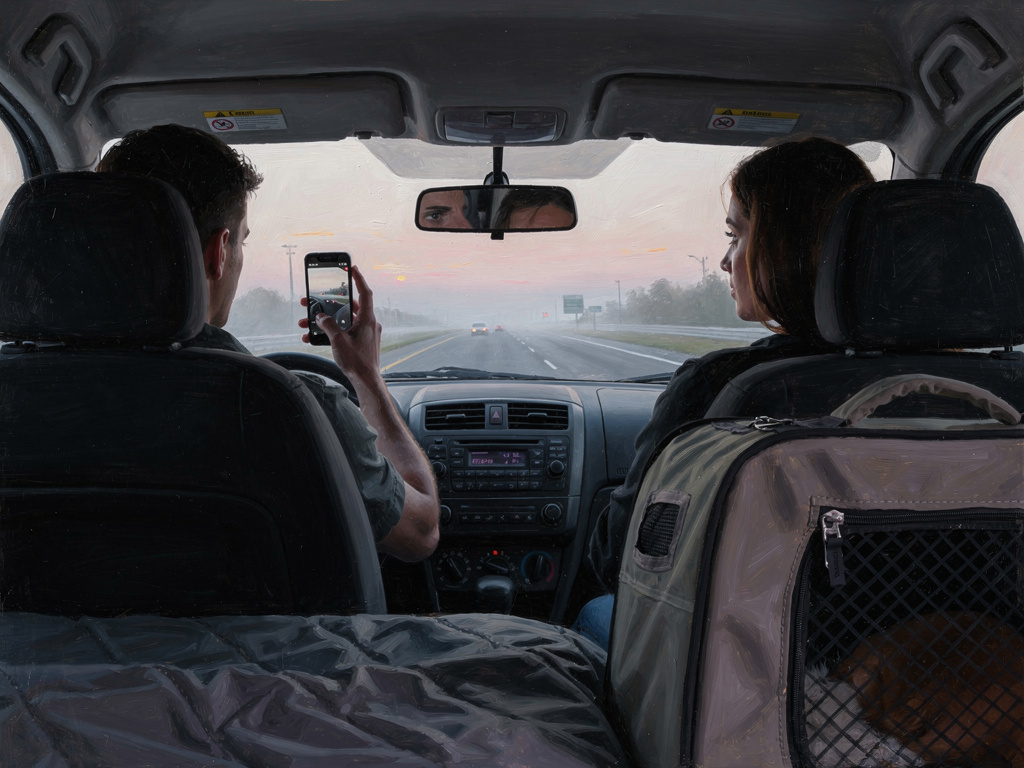
The sky stayed grey. The hills south of Lisbon, which had been golden in April, were the color of an old dishcloth. It was, by all accounts we would later receive from local residents, unseasonably cold and damp even by the standards of a region that is known for its cold and damp. The Algarve gets three hundred days of sunshine a year. We had arrived during one of the other sixty-five. We loaded the cat into the back. We loaded ourselves into the front. We drove.
Driving through the hills south of Lisbon, I noticed the state of charge declining.
This was not the normal rate of decline. This was the rate of decline of a vehicle that was cold, inefficient, and almost certainly both. Lithium batteries do not perform well in damp December weather. French engineering had, apparently, not chosen to compensate for this. These facts assembled themselves in retrospect with the inevitability of things that were obvious to everyone except the person they were happening to. By the time we cleared the southern suburbs, it was clear that we were going to arrive at the first charging stop with considerably less margin than I had planned for.
We arrived with thirty percent.
The Charger
Thirty percent is recoverable. Thirty percent, if the charger works, means we top up, continue, make the next station, reach Tavira. The math was still viable. I was not yet alarmed.
The charger did not work.
This is not a simple statement. It contains within it a sequence of events that anyone who has used non-Tesla charging infrastructure will recognize immediately and anyone who hasn't will find difficult to believe. The credit card reader declined. The QR code produced an error. The app — which I had downloaded and configured and tested successfully on a previous trip with a plug-in hybrid BMW, specifically as a warm-up exercise for exactly this situation — connected, authenticated, initiated a session, and then reported that the session had started while delivering no actual electricity to the vehicle. I tried the adjacent charger. Same result. I tried the third charger.
Standing in the early morning cold at a Portuguese motorway service area, holding a charging cable that the car would not accept charge from, with thirty percent remaining and the next station some distance down a road with no exits, I arrived at a conclusion I had been resisting for some time.
Tesla is the only company that has actually solved charging.
This is not a political statement. It is an infrastructure observation made by a person with twelve years of relevant experience, standing next to a broken charger at dawn in southern Portugal, whose position on the man who built that infrastructure is, to put it diplomatically, complicated. A psychopath sometimes makes things better. I did not enjoy acknowledging this. I acknowledged it anyway.
Archer was asleep in the back seat. Maria was looking at me with the expression of a person who has survived oncology wards and Portuguese immigration bureaucracy and is prepared to survive this too, but would prefer if we moved quickly.
We had thirty percent, a broken charger, and a plan to revise.
The Castle of Salt
The service plazas on the A2 are built in pairs — one on each side of the motorway, positioned across from each other so that you can see the people on the northbound side from the southbound side and vice versa. You can wave at them. You cannot reach them. The road between you is a controlled-access toll motorway with no provision for crossing at this location.
The next exit was twenty kilometers south: a town called Alcácer do Sal, which translates, with the straightforwardness of a place that has been doing one thing for a thousand years, as Castle of Salt.
At the Castle of Salt, there was a Tesla Supercharger.
I noted this with the specific feeling of a person observing a resource that is entirely useless to them. We were not in a Tesla.
The decision assembled itself quickly. We were not going to make Tavira. The math no longer worked — not with the charge we had, not with chargers that didn't function. The plan was to turn around, return to Lisbon, and accept whatever grim alternative the rental agency could produce. A diesel manual microcar at an extortionate rate. Whatever they had. Anything with a tank you filled from a pump that worked.
To turn around we had to drive south to the next exit, pay the toll, cross the motorway, and drive north past the service plaza we'd just left to the one on the other side. Forty kilometers, round trip, to end up directly across the road from where we were standing. This is one operational definition of insanity. We did it.
The chargers on the northbound side also didn't work.
We tried them all. Credit card, QR code, the app, sheer force of will, appeals to God — specifically the one who, I am told, cares deeply about what you do and especially what you do naked, and who I was addressing in terms suggesting that clothing was not currently my primary concern. On the fourth or fifth attempt, something connected. Not quickly. Not with any of the brisk authority of a Supercharger negotiating a handshake in under three seconds. More in the manner of a trickle charge from the same outlet you'd use for a toaster — the kind of charge that is, technically, charge, in the way that technically, you are moving if you shuffle across a room.
We bought salty snacks. I have a sodium deficiency, which is either a medical condition or a useful narrative explanation for why I eat what I eat, depending on who's asking. We sat in the grey of a Portuguese December motorway service plaza and waited for a French EV to accumulate enough electricity to get us back to Lisbon.
It was around noon when we returned the car.
Leon
Archer waited in the cold of the rental garage, in his carrier, with the patience of a creature who had already been to Portugal once today and had opinions about it that he was choosing not to share. I stayed with him. Maria went to deal with the counter.
She had nursed children through cancer. She knew, better than most people, what real suffering looked like, which meant she also knew that this — standing in a Lisbon rental garage on December 27th, holding a keycard to a French EV we were returning six hours after taking possession of it — was not real suffering. She knew this, and she did not let it show, because the oncology ward had also taught her that knowing something intellectually and performing it convincingly in front of strangers are different skills, and she had both.
The station was a madhouse. December 27th, the rental lot, post-Christmas surge. Every car spoken for. No ICE vehicles. They had, they explained, only electrics.
We did not want an electric car.
Maria pretended to cry.
She came back carrying a keycard that I recognized before she showed it to me. White. The shape of it. A Model 3, Long Range. The same trim level as Leon — her Tesla, the one she had said goodbye to at a CarMax lot in Florida two weeks earlier.
A thousand dollars more than we had planned to spend. We did not negotiate.
I got behind the wheel, engaged the autopilot, and punched in the Castle of Salt Supercharger as the destination. Ninety kilometers south. The car knew exactly where it was going.
The Supercharger connected in under three seconds. The display read: Charging rate: 520 km/h.
I have never been so happy to see a number in my life.
It felt comfortable. Not just warm, not just functional — comfortable, in the specific way that a system feels when it was designed by someone who thought the whole thing through. Archer was asleep in the back. Maria was quiet in the passenger seat. The sky was still grey. None of that had changed. But we were in a car that knew what it was doing, plugged into a charger that worked, and for the first time since 5:30 that morning, the situation was simply: fine.
We got to Tavira as the sun was going down.
Part 5: The flat. Three months, a Portuguese bureaucracy, and the language that was no longer optional.