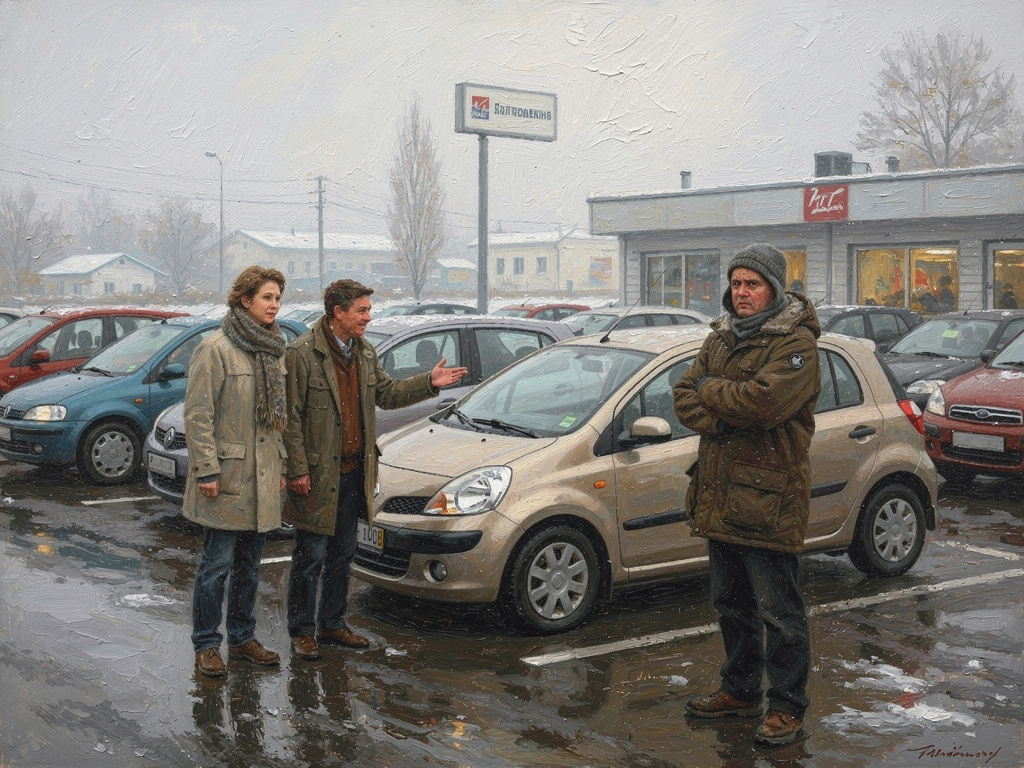
How LinguaMama Got Built, Part 6: The Yaris Cross
We got a car. Our visas were canceled. We hired a fixer. And somewhere in the middle of all of it, the hobby project became something else.
By Geordie Everitt
The $1,000-a-week Tesla was not going to be our long-term solution.
This was obvious from the moment we signed the rental agreement, but obvious things can be deferred when you've just spent a morning in a Lisbon parking garage watching your partner negotiate a Model 3 out of a chaotic post-Christmas crowd. We drove to Tavira in the Tesla. We rang in the New Year in Tavira. And then, in early January, we went looking for a car.
Not French
The search took us, inexplicably, to a Stellantis dealership in Faro.
I say inexplicably because I had recently spent a morning on the A2 with a French EV from Stellantis and had formed views. Maria had also spent that morning on the A2, but she is blissfully unencumbered by the automotive corporate genealogy that would have told her, immediately, that the Fiat she found on the lot and described as adorable was also a Stellantis product — the same conglomerate that had decided, at some point in the recent past, that merging Mopar and Fiat would produce something greater than either of its parts. It had not. Maria did not know this. She saw a cute car.
I reminded her of the C4.
The Toyota dealer was a fifteen-minute drive away. Early January at a car dealership is a particular experience — the showroom quiet, the salespeople attentive in the unhurried way of people who have no one else to talk to, the lot arranged with the slight pathos of merchandise waiting to be noticed. Nobody buys cars in early January. This is, for a buyer, an excellent time to buy a car.
I had owned a Prius. My 2009 Prius was the first new car I had ever bought — the only new car, in fact, until the Tesla four years later. I had given it to my sister when I took delivery of Phthalo Joule. It was not a Tesla. It was also, without question, the most reliable vehicle I had ever owned. Toyota builds things that work. This is not exciting, but it is, in the context of recent experience, an underappreciated virtue.
We left with a used Yaris Cross. A compact hybrid crossover that Toyota sells throughout Europe and does not bother to bring to the United States, presumably because Americans would find it insufficiently large. Dependable. Efficient. Not a Tesla, not French, not a plug-in requiring infrastructure that may or may not function. It started every time. Nothing about it was exciting. We were profoundly grateful for it.
LinguaMama
Somewhere in this stretch of early January settling-in — car acquired, flat organized, Archer's tile patch established, the wine situation well in hand — the project I had been running in the background required a more honest name.
It had started as vibe coding. An experiment. The intersection of a generic interest in learning a new language with thirty years of adjacent professional experience and a lot of opinions about how language acquisition actually worked, operationalized as a hobby app. The computational linguistics background, the machine learning intuitions, the comprehensible input thesis that Pablo Román's Dreaming Spanish had made vivid — these had converged into something I was building in the way that people with a particular kind of background build things: to see if they could, and then to see what it became.
It had become something.
The app is called LinguaMama.
The name is the thesis. You learned your first language from your mother — not from a textbook, not from a conjugation table, not from a gamified app that rewards you with a cartoon owl for correctly identifying the gender of a French noun. You learned it from stories. From picture books. From simple phrases repeated in context until they meant something. From being present in a language-rich environment and occasionally giggling when something funny happened. Nobody asked you to study. Nobody quizzed you. The only requirement was attention, and even that was optional on good days.
That is what LinguaMama does. Comprehensible input, delivered in the target language, calibrated just above where you currently are — the way a parent instinctively calibrates for a child, raising the bar gradually as the child rises to meet it. You watch. You listen. You let the prediction engine build. You don't study the grammar because you don't need to study the grammar; you acquire it the way a language model acquires it, from exposure in context, until the structure is implicit and the rules surface as feelings rather than facts.
Three years ago, this was not buildable by one person. The content alone would have required a production budget — native speakers, recording studios, professional translation at scale. The visual assets would have required illustrators or licensing. The voice work would have been synthetic in the uncanny, obviously-wrong way that made early text-to-speech systems useless for anything requiring trust.
That has changed, and it has changed fast, in the way that things change when the underlying capability jumps by an order of magnitude rather than incrementing. LinguaMama has the potential to support a hundred and forty-five native-level language variants. The synthetic voices are indistinguishable from human speech — not approximately, not to the untrained ear, but genuinely: the accent is right, the prosody is right, the stress falls where it should fall in a stress-timed language. The visual generation can render any style of object representation for any learning context. The translation layer can work in any direction across any of those variants.
And the code that builds it — the software infrastructure that makes all of this run — is substantially written by AI.
These blogs, for that matter, are substantially written by AI.
I want to be precise about what that means, because precision matters here and the vague version is easy to misread. The voice is mine. The facts are mine — I lived them, nobody else did. The opinions are mine, formed over thirty years in a field I understand. What AI contributes is the craft of making the written version of all of that as good as it can be: structure, rhythm, word choice, the specific discipline of not beginning a paragraph with "In today's rapidly evolving." I have been working with these systems long enough to know what they can and cannot do, and what they can do now, in early 2026, is genuinely different from what they could do when most people started paying attention.
LinguaMama is the same argument, applied to language acquisition. The tool is capable of things that were unavailable at any reasonable cost just a few years ago. The question is what you build with it.
I was, by January in Tavira, its most committed user. This is either a good sign or a conflict of interest, depending on how you look at it.
The Fixer
The visa situation had not resolved itself, which is the natural behavior of visa situations left to their own devices.
We had written letters. We had made inquiries. We had corresponded with the Portuguese immigration authority in the patient, documented way of people who believe that bureaucratic systems respond to evidence and good faith. Both of our visas were officially canceled. We were, in the language of the notification, invited to return to the United States and initiate the application process again from the beginning.
We hired a fixer.
This is a recognized role in the expat community — someone with local knowledge, bureaucratic contacts, and a track record of navigating situations that the official channels handle with their characteristic warmth. Ours was good at her job. She began working the phones. She explored options we had not considered: establishing residence in Rhode Island as a paper address, which is apparently a thing that exists and that people do, for reasons I chose not to examine too closely.
We made a plan. A friend in Little Pine Island would put us up while we were in Florida. We would go back to Pinellas County, see family, see friends, do the rounds. Then Ottawa — a friend there had access to a corporate apartment — where we would stay while the process ground through whatever it needed to grind through. The VFS process would likely still run through the United States; Canada was where we would be while waiting, not necessarily where we would be applying from. The distinction matters less than it sounds, because either way the passports would be in a diplomatic pouch somewhere and we would be in a North American holding pattern of indeterminate duration.
It was not a great plan. There were many points at which it could go wrong, and we knew most of them by name.
The Portuguese consulate would have our passports during the process. Canada requires a passport to enter from the United States. We would need passport cards — a document most Americans have no reason to acquire, which allows land and sea crossing into Canada when your actual passport is sitting in a diplomatic pouch somewhere in Lisbon.
We drove to Lisbon to submit the passport card paperwork in person at the American Embassy. Our trust in postal bureaucracy had been thoroughly retired.
The A2, Again
The weather on the way up was worse than December. Hurricane-force winds. The kind of driving that reminds you that a compact hybrid crossover has more sail area than a Toyota engineer optimized for. The Yaris Cross did not complain. Neither did we, particularly. We had done this road before, and we had, this time, no range anxiety to compound the experience.
Halfway up, somewhere in the grey Alentejo flatlands south of Setúbal, the fixer's text arrived.
No dice.
There is a phrase — deployed, usually, by a host who has had enough and is too polite to say so directly — that goes: you don't have to go home, but you can't stay here. It is a party-ending construction dressed as an accommodation. Portugal, through the medium of a text message on the A2, had just said it to us.
I looked at Maria.
"Why don't we try Spain?"
She looked at me.
"Why don't we try Spain?"
That was it. The same quality of exchange as a kitchen conversation on the evening of November 6th, 2024. Not a debate. Not a negotiation. A recognition of something that had already been decided by the time the words arrived.
We stopped at the same service plaza we had christened with our first Portuguese EV disaster. Bought salty snacks. Walked back to the Yaris Cross. The next exit north was thirteen kilometers up the A2.
We turned around and drove back to Tavira.
Part 7: The Spain visa. The DNV. And the language question, which had now changed languages twice.