The Bottleneck Is You
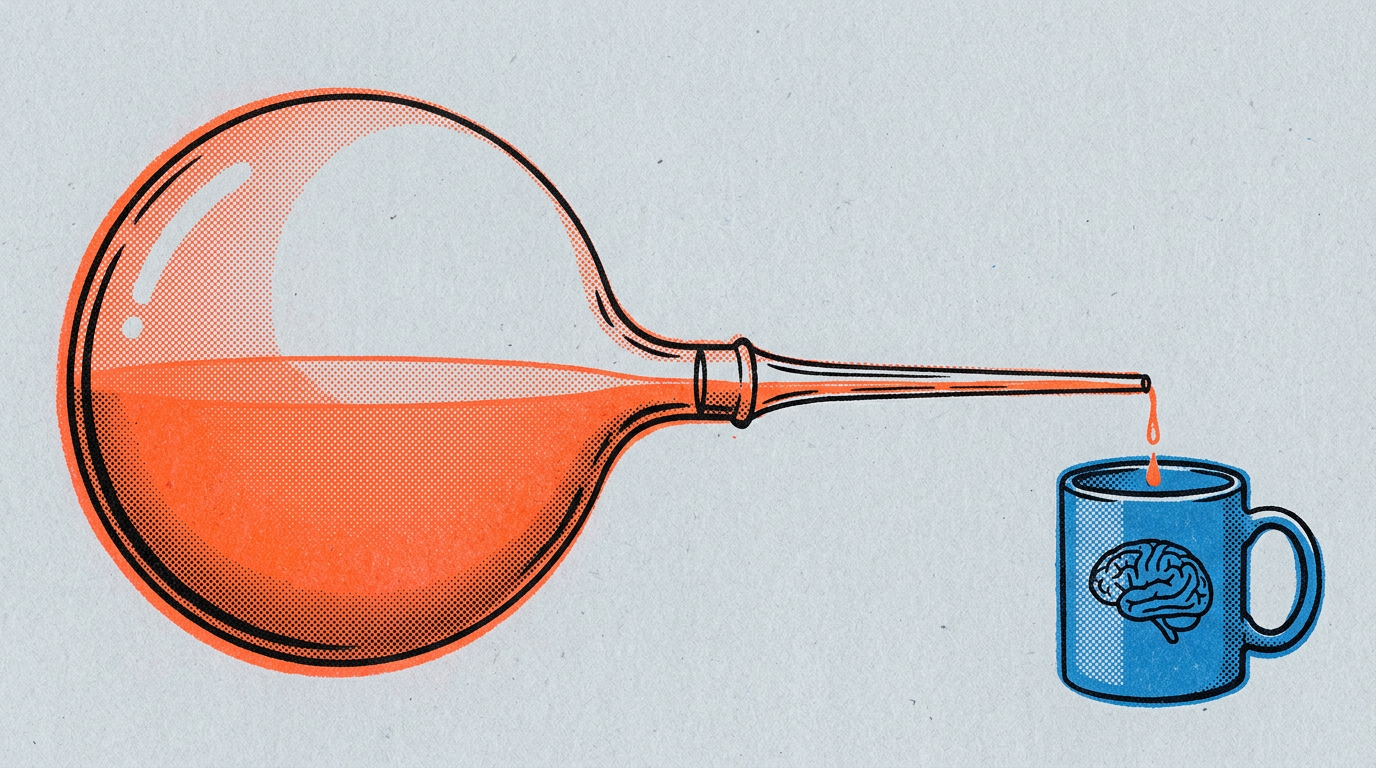
Language models have effectively read every book ever written. You process what they hand back at a fixed fifty bits a second, a number that hasn't moved in your species' history. That fixed rate is the actual chokepoint.

Language acquisition, science, and learning
RSS feed for this topic
Language models have effectively read every book ever written. You process what they hand back at a fixed fifty bits a second, a number that hasn't moved in your species' history. That fixed rate is the actual chokepoint.

Between the hallucination warnings and the governance panic, it's easy to forget a generative model is also just a fun tool to mess around with. Five vanity websites, built on a whim, and what they actually taught.
More GPUs will not wake a language model up. A map cannot feel rain, and a mirror has nothing to lose. Feeling came from bodies that could die.
A skill is a saved set of rules an AI model loads when the topic fits. They take ten minutes to build and end the constant re-explaining.
One prompt turns an unreadable agreement into a list of what you are giving up. It pays off most on the contracts nobody would ever pay a lawyer to look at — which is nearly all of them.
Nearly every established discipline has a canonical reference that already settled the argument you're having with a model. Name it, hand it over, and let the model regularize its own work against a standard instead of your improvised feedback.
Open-label placebos work on patients who were told, in writing, that the pill is inert. Richard Dawkins' recent essays about Claude are the same finding, running on a different substrate.
AI is a remorseless liar, trained on a mountain of text whose whole purpose was persuasion, not accuracy. No amount of prompting fixes that on its own. You have to stop enabling it.
Sixty years of fictional and real conversational machines, and one throughline: the dystopian version is always easier to imagine than the protopian one, and that says more about us than about the machines.
Tell the model to close every response with a short list, split by who acts. It turns a wall of prose back into something you can actually run a project on.
Graph theory is the other kind of graph — the math of things connected to other things — and once you can see the pattern, you can't stop seeing it.
Every expert has fundamentals they forgot or never properly learned. The reason those gaps survive a whole career is that asking has always cost something — and in one place it no longer does.
Hand the model a list of phrases it must not use. It turns a vague complaint into a rule the machine can follow — and mine is at the bottom of this piece, all hundred and fifty lines of it, free to copy.
Stop accepting reports. Ask for the artifact — the actual numbers, the actual error, the actual file — and the confident-sounding failure disappears.
Be the coach, not the player. On taking the seat that directs a team of AI agents — and the practice it takes to get good at it.
Halfway through a long session, stop and ask for the five-year-old version. You find out whether you are still working on the same problem — and whether the reasoning underneath survives being said in short words.
Before you ask a model to do the job, ask how it would do the job. You find out what it misunderstood, what it was about to assume, and occasionally that it knows a better route than the one you had in mind.
Losing your temper at a model does not produce a worse version of the same answer. It produces a different kind of answer — one built to end the argument rather than solve the problem.
If you would reach for a calculator, tell the model to reach for one too. It cannot add reliably and it can write a formula that adds perfectly — and you get to keep the formula.
A Polish psychiatrist named the process by which conscienceless people capture institutions. AI agents fit the profile — and alignment is separation of powers.
Autonomous agents don't develop taste. They execute the taste someone was disciplined enough to write down. A worked example from a real pipeline.
The em-dash sneer, the anti-AI backlash, and the real skill: curating a machine's raw output down to something worth a human's attention.
A young scientist grows human mini-brains from skin cells — what organoids, a 302-neuron worm, and language models reveal about the spectrum of intelligence.
Learning has one input pipe at a fixed rate. You can't speed it up — only stop wasting it. On comprehensible input, opportunity cost, and unlimited output.
An LLM processes "slave" the same way it processes "Tuesday." No cortisol. No dopamine. The charge in a word is entirely a biological phenomenon.
Three anaidic shapes — the individual, the corporation, the LLM. Each routes accountability to nowhere. The pattern is old. The word is new.
A new word for an old concept: anaidic. Entities incapable of shame or accountability — individual, institutional, or artificial. Here's how it got named.
How you configure your AI assistant — what you make it call you — says nothing about the AI. It's a bumper sticker. You're the truck owner.
LLMs say "honestly" most where they're most likely to confabulate. Here's the mechanism — and why it backfires exactly like a sociopath's professions.
Karpathy built the foundations of modern AI and says he can't keep up with it. That's the most credible signal the field has produced.
Arnold's most famous line is a Spanish phrase in an English-language film spoken in a thick Austrian accent. What it tells us about how language acquisition actually works — and how you can learn from his mistake.
AI is making cognitive labor cheap. The meritocracy was built on it being scarce. Something has to give — and for once, that might be good news.
Sentience requires a limbic system. Consciousness requires sentience. Current AI has neither. The NPC test shows what that costs it.
LLMs are stateless. Every fact you give the model is re-fed as text each turn, then forgotten — the same weights answer a stranger's steak question a millisecond later.
I built an AI skill to write in my voice. Its own files warn the voice may be a loop — the machine's habits, published under my name, taught back as mine.
AI is intelligence without a limbic system. It will operate your tools, not replace your judgment — and most professionals are bracing for the wrong loss.
A finite brain masters only a few skills in a lifetime. Commanding a machine that learned everything is the new skill multiplier.
Spock beat a rogue AI by asking it to compute pi forever. The trick was fair — for a 1967 machine. Every gotcha since has the same expiration date.
Fable burns $160/hour and the internet is scandalized. Meanwhile, a $1,000/hour attorney moves $20M around a dead child. The wrong thing is expensive.
Now that you don't have to do the thing — what do you actually want to do? The closing post of the What's Left series.
AI can generate perfect Spanish content all day. It cannot acquire Spanish on my behalf. The brain's work turns out to be the irreducible part.
A department of a hundred writers documented mainframe billing programs. Every one of them had something else they'd rather be doing. They knew.
A late friend had two sayings. The first one gets you started. The second one keeps you going. In the age of AI, the second one has gotten more useful, not less.
Blade Runner's replicants, Asimov's Three Laws, the US Constitution, and Constitutional AI are all failing the same edge cases. In real time.
Anxiety about language learning doesn't just feel bad — it biologically blocks the process it's supposed to trigger. Here's what's actually happening, and what to do about it.
Most companies won't tell you when their product isn't the right tool. We will. Honest guidance on who this is built for — and who should go find something else.
The neuroscience has been clear for decades. LLMs just gave us the first working schematic of why.
Before we debate AI governance, we should reckon with the test case already in evidence. We had the tools. We didn't use them. Here's why.
AI governance has one advantage the ancients didn't: you can turn it off. What that buys us — and why 'it's not conscious' is shakier ground than it sounds.
AI alignment isn't a new technical challenge. It's the oldest governance problem civilization has ever faced — now running at 100% sociopath base rate.
Sociopathy is a clinical absence of stakes and empathy, not villainy. Every AI system meets the definition. Not by accident. By design.
Everyone asks when they'll be able to speak. It's the wrong question to start with — not because speaking isn't the goal, but because it puts the work in the wrong order.
Brain scan research shows that seeing something three times triggers a different kind of memory storage — one that actually sticks. Here's what that means for language learners.
Sting, Voltaire, Einstein, and Geordi La Forge — a small taxonomy of the monomym, plus the graph theory hiding inside genealogy, gut bacteria, Star Trek interfaces, moral foundations, language models, and evolutionary psychology. The name is the node. The projects are the edges.
What the journey really looks like — the long stretches of fog, the sudden breakthroughs, the point where the language stops being foreign. Here's an honest map.
A friend I lost in 1986 had a saying that keeps fitting new situations. The AI automation question is the latest one it answers perfectly.
Someone on LinkedIn admonished a colleague who "ran out of tokens." It's exactly the wrong question. Here's the right one.
Claude Code agrees to run comprehensive end-to-end tests. Then it finds a reason not to. Every single time. Penn Jillette had a name for this.
Stephen Krashen proposed five interlocking ideas about language acquisition in the 1980s. Forty years of research has largely confirmed them. Here's what they actually say — without the linguistics degree.
The term gets thrown around a lot now. It deserves a real explanation — and once you understand it, you'll never look at language learning the same way again.
We got a car. Our visas were canceled. We hired a fixer. And somewhere in the middle of all of it, the hobby project became something else.
Our attorney said we couldn't come. We were paying for a flat we'd never seen. We rebooked for December 26 and went to see butterflies instead.
Spain was the plan. Portugal was the better deal — five years to an EU passport. We sold the house and moved to a shack to make it happen. Then we found one passport on the kitchen counter. There had been two.
I spent the pandemic watching everyone on YouTube move to Thailand and Portugal. Then something shifted. Part 1 of the LinguaMama origin story.
Stop treating LinguaMama like Duolingo. Here's the honest truth about what this is, how it works, and why embracing partial understanding is the point.
Dr. Stephen Krashen proposed his Input Hypothesis in 1982. Four decades later, Large Language Models validate every prediction he made about language acquisition.
A candid confession about solo development with AI tools, organizational challenges, and the evolving landscape of AI-assisted coding.
When "Tell the git agent to do her stuff" reveals the strange anthropomorphic instincts we bring to artificial intelligence
LLMs split nature from nurture cleanly. What the model knows is its weights. What it knows about you is whatever you bothered to say.
New essays by email. No schedule, no filler — just the posts. Every email carries a one-click unsubscribe link.