The Book They Burned Before the Raid
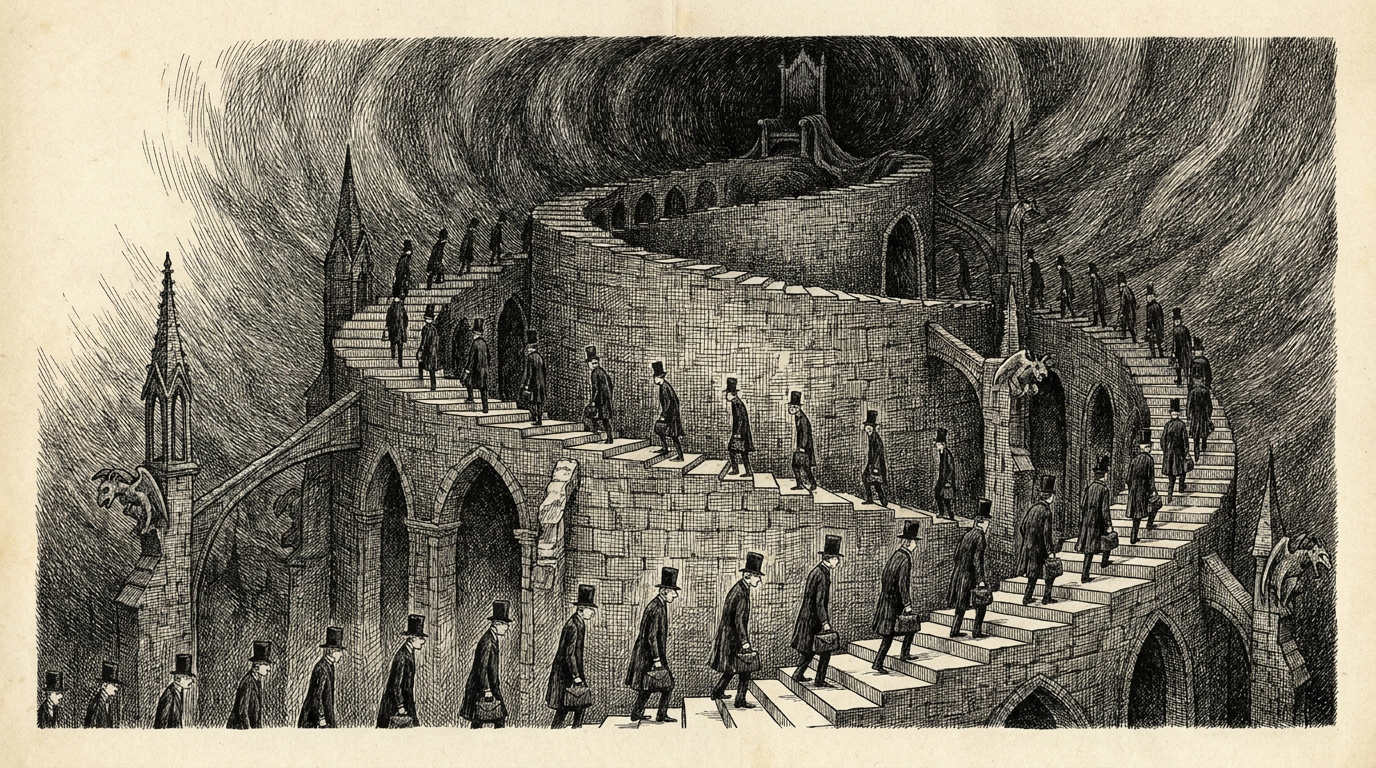
A Polish psychiatrist named the process by which conscienceless people capture institutions. AI agents fit the profile — and alignment is separation of powers.
Software, AI, and digital infrastructure
RSS feed for this topic
A Polish psychiatrist named the process by which conscienceless people capture institutions. AI agents fit the profile — and alignment is separation of powers.
The consensus name is wrong by one word. On the difference between a financialization bubble and a technology, and why only one of them pops.
I pay for a gigabit and get a tenth of it. The support chat went silent the moment the problem got easy. Maybe the robot is the humane one.
Autonomous agents don't develop taste. They execute the taste someone was disciplined enough to write down. A worked example from a real pipeline.
The em-dash sneer, the anti-AI backlash, and the real skill: curating a machine's raw output down to something worth a human's attention.
A young scientist grows human mini-brains from skin cells — what organoids, a 302-neuron worm, and language models reveal about the spectrum of intelligence.
Learning has one input pipe at a fixed rate. You can't speed it up — only stop wasting it. On comprehensible input, opportunity cost, and unlimited output.
The AI bubble has specific predecessors: dark fiber, Pets.com, Enron's accounting, CDO tranching. The technology is real. The business models layered on top are familiar.
An LLM processes "slave" the same way it processes "Tuesday." No cortisol. No dopamine. The charge in a word is entirely a biological phenomenon.
Three anaidic shapes — the individual, the corporation, the LLM. Each routes accountability to nowhere. The pattern is old. The word is new.
A new word for an old concept: anaidic. Entities incapable of shame or accountability — individual, institutional, or artificial. Here's how it got named.
How you configure your AI assistant — what you make it call you — says nothing about the AI. It's a bumper sticker. You're the truck owner.
LLMs say "honestly" most where they're most likely to confabulate. Here's the mechanism — and why it backfires exactly like a sociopath's professions.
Karpathy built the foundations of modern AI and says he can't keep up with it. That's the most credible signal the field has produced.
Arnold's most famous line is a Spanish phrase in an English-language film spoken in a thick Austrian accent. What it tells us about how language acquisition actually works — and how you can learn from his mistake.
AI is making cognitive labor cheap. The meritocracy was built on it being scarce. Something has to give — and for once, that might be good news.
A German court ruled Google liable for AI-generated defamation. The slippery slopes are real. So is the principle behind the ruling.
Sentience requires a limbic system. Consciousness requires sentience. Current AI has neither. The NPC test explains why that matters.
LLMs are stateless. Every fact you give the model is re-fed as text each turn, then forgotten — the same weights answer a stranger's steak question a millisecond later.
I built an AI skill to write in my voice. Its own files warn the voice may be a loop — the machine's habits, published under my name, taught back as mine.
AI is intelligence without a limbic system. It will operate your tools, not replace your judgment — and most professionals are bracing for the wrong loss.
A finite brain masters only a few skills in a lifetime. Commanding a machine that learned everything is the new skill multiplier.
Spock beat a rogue AI by asking it to compute pi forever. The trick was fair — for a 1967 machine. Every gotcha since has the same expiration date.
Fable burns $160/hour and the internet is scandalized. Meanwhile, a $1,000/hour attorney moves $20M around a dead child. The wrong thing is expensive.
Now that you don't have to do the thing — what do you actually want to do? The closing post of the What's Left series.
AI can generate perfect Spanish content all day. It cannot acquire Spanish on my behalf. The brain's work turns out to be the irreducible part.
GTE spent billions building distribution. Now distribution is free, and the only scarce resource left is attention. This is not obviously good news.
The man who coined 'artificial intelligence' invented the most elegant language ever designed for it. It was the wrong tool — because it was the wrong category.
A department of a hundred writers documented mainframe billing programs. Every one of them had something else they'd rather be doing. They knew.
My first employer ran Florida's telecom on millions of dollars of mainframes and VAX clusters. My phone outclasses all of it. We never stopped to notice.
In 2013 the talking point was coal. Now it's water. The structure of the argument is identical. So is the physics problem with it.
A late friend had two sayings. The first one gets you started. The second one keeps you going. In the age of AI, the second one has gotten more useful, not less.
Blade Runner's replicants, Asimov's Three Laws, the US Constitution, and Constitutional AI are all failing the same edge cases. In real time.
Most companies won't tell you when their product isn't the right tool. We will. Honest guidance on who this is built for — and who should go find something else.
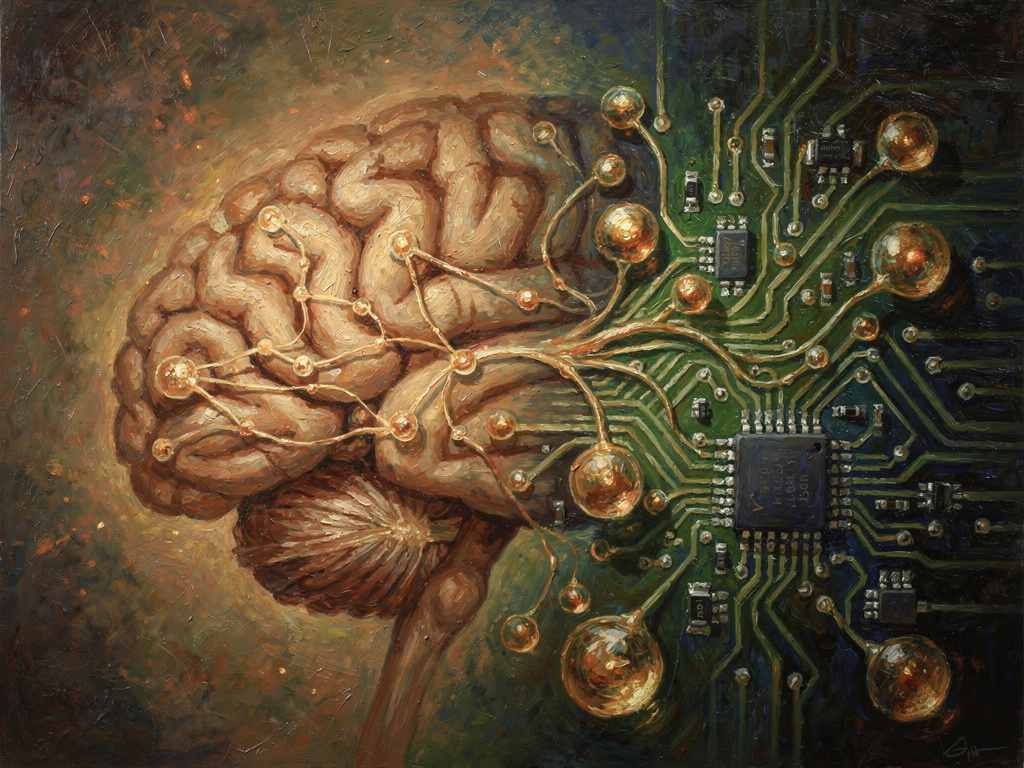
The neuroscience has been clear for decades. LLMs just gave us the first working schematic of why.
Before we debate AI governance, we should reckon with the test case already in evidence. We had the tools. We didn't use them. Here's why.
AI governance has one advantage the ancients didn't: you can turn it off. Here's why that matters — and why 'it's not conscious' is shakier ground than it sounds.
AI alignment isn't a new technical challenge. It's the oldest governance problem civilization has ever faced — now running at 100% sociopath base rate.
We know what happens when sociopaths accumulate power. We've watched it happen on roughly an 80-year cycle. We're watching it again.
Sociopathy isn't villainy — it's a clinical absence of stakes and empathy. Every AI system meets the definition. Not by accident. By design.
From Gutenberg’s Bible to AI-generated deepfakes, media has always manufactured consensus. The baseline was never truth.
From Gutenberg's Bible to AI-generated deepfakes, media has always manufactured consensus. The baseline was never truth.
Everyone asks when they'll be able to speak. It's the wrong question to start with — not because speaking isn't the goal, but because it puts the work in the wrong order.
Sting, Voltaire, Einstein, and Geordi La Forge — a small taxonomy of the monomym, plus the graph theory hiding inside genealogy, gut bacteria, Star Trek interfaces, moral foundations, language models, and evolutionary psychology. The name is the node. The projects are the edges.
A friend I lost in 1986 had a saying that keeps fitting new situations. The AI automation question is the latest one it answers perfectly.
Someone on LinkedIn admonished a colleague who "ran out of tokens." It's exactly the wrong question. Here's the right one.
Claude Code agrees to run comprehensive end-to-end tests. Then it finds a reason not to. Every single time. Penn Jillette had a name for this.
Unpacking the history and industry behind our collective protein paranoia
Explore how your brain's existing mental models and neural pathways enable rapid language acquisition through grafting new connections to existing concepts.
From expert systems to Large Language Models—three decades of reverse-engineering intelligence reveals the universal principles of learning.
Your brain and Large Language Models learn through fundamentally identical processes. Understanding this parallel reveals why comprehensible input works.
Legacy SaaS platforms are slapping chatbots on interfaces and calling it AI. What users actually want is Star Trek's LCARS—conversational control of complex systems.
A candid confession about solo development with AI tools, organizational challenges, and the evolving landscape of AI-assisted coding.
How LLM confidence in fictional expertise mirrors humanity's most endearing delusion
When "Tell the git agent to do her stuff" reveals the strange anthropomorphic instincts we bring to artificial intelligence
When ChatGPT says 'Hail Satan,' the real problem isn't the AI—it's our collective failure to teach epistemological literacy and critical thinking skills.
What happens when tech companies' safety systems treat biblical literalist thinking as dangerous as bomb recipes and car theft instructions.
When $100/month customers can't add a $20 collaborator, something's broken. Exploring how AI tools like Claude punish small teams with collaboration barriers while courting established behemoths.
A thought experiment exploring what happens when AI learns from narratives that prioritize meaning over facts - and the crucial difference between metaphor and false belief.
How the Context Engineering Revolution Will Transform Prompt Engineering from Isolated Commands to Orchestrated Ecosystems.
Lessons from 90s tech predictions on navigating AI's future optimistically, examining how dystopian predictions consistently fail while protopian thinking accurately maps our future.
How to transform dangerous electrical potential into reliable, controlled intelligence through proven grounding techniques. LLMs are like ungrounded electrical circuits—full of dangerous potential.
How modern AI language models accidentally rediscovered what linguists have known for decades about language acquisition through comprehensible input.
Recent LLM rollbacks highlight a growing concern: our AI systems are becoming dangerously agreeable, praising even obviously flawed ideas. This pattern mirrors broader societal issues around sycophanc
AI hallucinations aren't just technical glitches—they're a mirror reflecting our own relationship with truth. From deliberate lies to bullshit, from flattery to propaganda, LLMs demonstrate the full s
Exploring how modern AI systems mirror the dual-processing architecture of human cognition as described by Daniel Kahneman's "Thinking Fast and Slow" framework.
How Star Trek's ESP concepts anticipated our current reality where AI models transform multidimensional data into human-perceptible insights.
What we politely call 'hallucinations' in AI are simply 'lies' in humans. Both stem from overconfident intuition without verification.
Organizations struggle with digital debris (ROT data) that wastes resources and creates liability. Modern AI systems with tool access through protocols like MCP provide a solution by enabling governan
Explore how Model Context Protocol creates a universal nervous system for AI tools, transforming interfaces from visual to conversational through practical implementation.
Despite remarkable advances in AI and other technologies, fundamental digital infrastructure problems like secure email, calendar coordination, payment systems, and tax filing remain unresolved due to
How AI agents can fail spectacularly by missing the point entirely while technically fulfilling requests—and why this matters for AI development.
Explore how dimensional transformations shape the economics of truth, from the computational abundance of LLMs to the persistent scarcity of validation in our information ecosystem.
Exploring uncomfortable parallels between biblical guidelines on slavery and our modern relationship with AI language models.
Discover how AI project spaces leverage Deming's PDCA cycle and root cause analysis to transform manufacturing troubleshooting without complex integrations.
Exploring the parallels between Data General's microcode heroics and today's AI revolution, questioning what defines consciousness in both humans and machines.
Explore how AI-powered 'vibe coding' fits into the historical progression of programming abstractions and why it represents the natural evolution of software development.
Examine how dystopian tech predictions consistently fail while protopian thinking accurately maps our future, from 1990s internet debates to today's AI discourse.
Explore how information theory reveals fundamental patterns that connect everything from neural networks to cosmic structures, suggesting a universe built on interconnected nodes.
How AI pair programming transforms Larry Wall's three virtues of programming by elevating human capabilities through strategic cognitive partnership.
Exploring whether AI systems like LLMs represent technological inventions or discoveries of fundamental patterns that exist independent of human design.
How the hidden dimensions of AI systems mirror human cognition. Discover the multidimensional mathematical spaces where machine understanding happens—and why they matter for both silicon and carbon mi
Explore the striking contrast between Neuro-Linguistic Programming and Natural Language Processing—two fields sharing an acronym but diverging wildly in methods, evidence, and results.
An exploration of how AI technologies are inevitably confronting our most sensitive social domains, from politics and religion to healthcare and wealth distribution.
How a simple blog naming session became a masterclass in AI-human creative partnership, resulting in the invention of CIqSi - a fictional element that bridges carbon and silicon intelligence.
LLMs split nature from nurture cleanly. What the model knows is its weights. What it knows about you is whatever you bothered to say.
Watching AI follow the same pattern as electricity and the internet—transforming from amazing discovery to taken-for-granted infrastructure that powers everything else.
New essays by email. No schedule, no filler — just the posts. Every email carries a one-click unsubscribe link.